
ChatGPT Ads are paid advertising placements that appear separately from ChatGPT’s AI-generated answers. They allow businesses to promote relevant products or services while users explore options, compare alternatives, and make decisions through conversation. Ads are selected using signals such as conversational context, ad content, landing-page relevance, and advertiser-provided context hints.
ChatGPT Ads went live for Indian users on 27 August 2026, followed by the launch of the self-serve ChatGPT Ads Manager for Indian advertisers on 4 September 2026, with a minimum daily budget of Rs 725. Unlike Google or Meta, ChatGPT Ads are driven by conversational intent rather than keywords or demographic targeting.
For businesses, ChatGPT advertising introduces another way to reach potential customers. Understanding how it differs from traditional search advertising, what it costs, and how results are measured is essential before allocating a marketing budget.
What are ChatGPT Ads?
ChatGPT Ads are sponsored placements displayed within the ChatGPT experience. They allow advertisers to introduce their offerings when the context of a conversation makes those offerings relevant.
For example, a person discussing customer relationship management software might encounter an advertisement for a CRM product. Someone comparing online learning options might see a relevant education-related ad, provided an eligible advertiser and suitable placement are available.
These are illustrative scenarios, not confirmed campaign examples.
OpenAI describes ChatGPT advertising as a system designed around relevance, user trust, privacy, and the independence of ChatGPT’s answers. Ads are clearly labelled and separated from the assistant’s response. Advertisers cannot pay to change or rank the organic answers ChatGPT generates.
ChatGPT Ads are different from AI-assisted advertising
The term can refer to several distinct activities. Understanding the differences prevents confusion when evaluating advertising opportunities.
| Activity | What it means |
| ChatGPT Ads | Paying to display sponsored placements inside ChatGPT. |
| AI-assisted advertising | Using ChatGPT to draft ad copy, brainstorm campaigns, analyse reports, or develop marketing strategies for other platforms. |
| Organic AI visibility | Improving the likelihood that useful website content is discovered, referenced, or surfaced in AI-generated answers. |
| ChatGPT recommendations | Information or recommendations produced by the assistant, which are not automatically paid advertisements. |
A business can use all these approaches, but they require different strategies, budgets, and measurement methods.
How do ChatGPT Ads work?
ChatGPT Ads combine advertiser campaign settings with contextual signals from a conversation. Advertisers provide their offering, creative assets, landing page, and campaign instructions. The advertising system then determines whether an eligible ad is relevant to a particular opportunity.
The ChatGPT advertising process
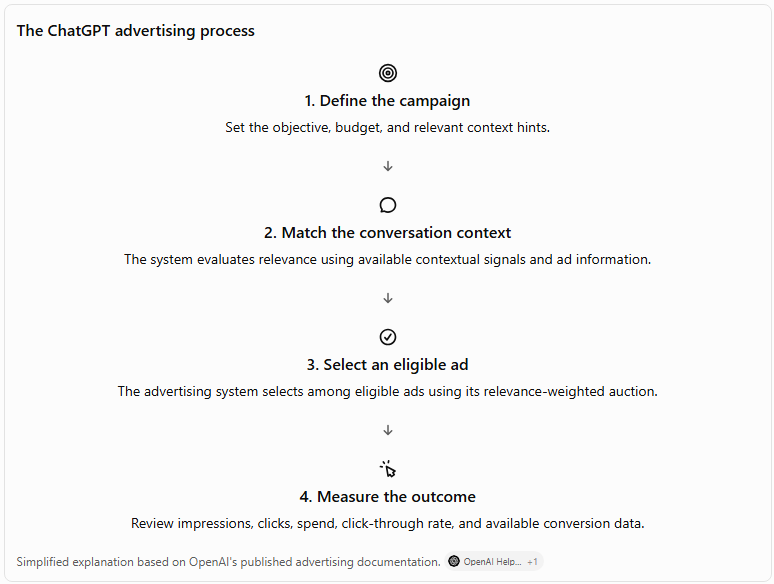
Step 1: An advertiser creates a campaign
The advertiser chooses a campaign objective and provides the necessary campaign settings, creative content, and landing-page destination.
The campaign can be designed around reach, traffic, or supported conversion objectives. The available options depend on the current Ads Manager features and advertiser eligibility.
Step 2: The advertiser defines relevant context
Instead of relying exclusively on a list of exact-match search keywords, ChatGPT Ads uses richer contextual signals. Advertisers can provide context hints at the ad-group level. These describe conversations, topics, or keywords in which an offering might be relevant.
For example, a project management software company might provide context hints around:
- Comparing project management platforms.
- Managing distributed teams.
- Automating repetitive business workflows.
- Selecting software for a growing company.
These hints guide ad matching; they do not guarantee that an ad will appear in a particular conversation.
Step 3: The system evaluates relevance
The advertising system considers several signals, including the current conversation, the ad’s title and description, the landing page, advertiser-provided context hints, and selected broader user-experience signals when ad personalization is enabled.
OpenAI also documents a relevance-weighted, second-price auction among eligible ads. This means the system does not simply display every advertisement whose topic matches a conversation. Eligibility, relevance, bidding, and the available advertising opportunity all matter.
Step 4: A sponsored placement appears
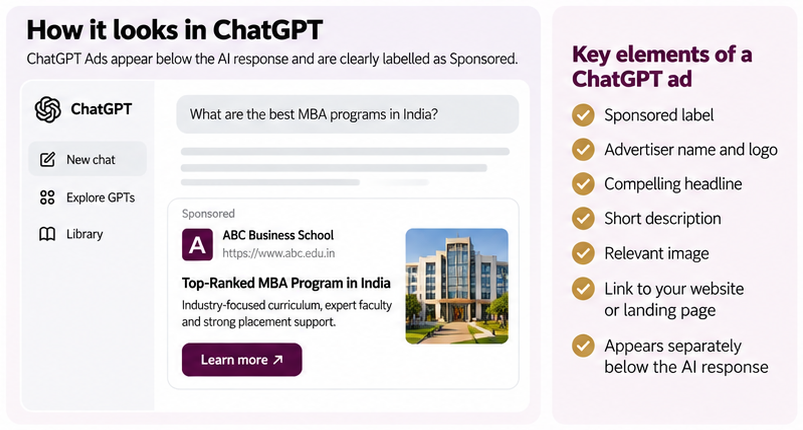
When an appropriate ad is selected, it may appear below the end of a ChatGPT response. It is clearly marked as sponsored and visually separated from the organic answer.
The advertisement can direct the user to the advertiser’s landing page. Whether a specific ad is shown depends on factors including relevance, eligible inventory, settings, and campaign delivery.
Step 5: The advertiser evaluates performance
Advertisers can use Ads Manager reporting to monitor impressions, clicks, spend, click-through rate, average cost per click, average cost per thousand impressions, and conversions where conversion measurement is configured.
This allows businesses to evaluate whether the advertising spend is generating useful traffic and commercially meaningful outcomes rather than relying only on visibility.
Where do ChatGPT Ads appear, and what do they look like?
ChatGPT Ads can appear below ChatGPT responses. According to OpenAI’s advertiser documentation, an ad unit includes:
- Advertiser name.
- Favicon or advertiser logo.
- Headline or title.
- Descriptive copy.
- Landing-page destination.
- An image creative.
The exact experience can evolve as OpenAI tests new advertising formats. The published format should therefore be checked again before campaign creative is prepared.
Do ChatGPT Ads appear in every conversation?
No. An advertisement is not guaranteed to appear in every conversation. Ad delivery depends on eligibility, available inventory, relevance, campaign configuration, and other delivery signals.
This distinction matters for advertisers: choosing a topic does not guarantee access to every user discussing that topic.
Who can advertise on ChatGPT in India?
OpenAI announced on 31 August 2026 that direct ChatGPT advertising purchases through Ads Manager were expanding to India, Europe, the Middle East, and North Africa. Its current advertiser documentation describes Ads Manager Beta and directs businesses to the availability page for the latest country-specific access.
For an Indian business, the practical starting point is the official OpenAI Ads Manager.
Before planning a launch, verify:
- Whether your business and account can access Ads Manager.
- Whether your advertiser account requires verification.
- Which campaign objectives and bidding options are available.
- Whether your products, services, creative assets, and landing pages comply with OpenAI’s advertising policies.
- Which billing and payment arrangements are available for your account.
India’s availability does not mean every business, industry, account, or campaign is automatically eligible. Account access and ad approval remain important considerations.
How to get started with ChatGPT advertising?
Businesses exploring ChatGPT advertising should follow a structured process rather than immediately allocating a large budget.
1. Check account access
Visit the official ChatGPT Ads platform and confirm whether self-service access is available for your business.
2. Select a measurable objective
Choose an objective that matches the intended business outcome.
- Reach: Introduce a product or service to relevant users.
- Traffic: Encourage users to visit a landing page.
- Conversions: Optimise towards a supported conversion event when the required measurement and eligibility conditions are met.
The exact available options should be confirmed in Ads Manager.
3. Define your audience context
Identify the problems, decisions, and product comparisons that make your offer relevant. Convert these into specific context hints and distinct advertising messages.
For example, a hypothetical B2B software company might develop separate messages for teams evaluating project management software, businesses automating reporting, and managers looking to improve collaboration.
4. Prepare clear advertising creative
Explain what the product does, who it helps, and why it may be useful. Avoid vague headlines and exaggerated promises.
OpenAI recommends using distinct creative variations that communicate different benefits rather than repeating essentially the same message. All creative and landing-page content must comply with the platform’s policies.
5. Build a relevant landing page
The destination should continue the message introduced by the ad. It should clearly explain the offer, provide useful supporting information, and make the next step easy to understand.
For lead-generation campaigns, that next step might be a consultation request, a product demonstration, or an enquiry form.
6. Set up billing and measurement
Configure the account’s billing details and payment method or applicable invoice arrangements. Set up conversion measurement where supported and add UTM parameters to landing-page URLs so traffic can also be analysed in existing analytics tools.
7. Review results and improve the campaign
Evaluate the campaign against its objective. Improve weak creative, landing-page relevance, or campaign settings based on observed results.
Do not assume that an early campaign will immediately produce a predictable cost per lead or return on advertising spend. OpenAI states that broad performance benchmarks across advertisers, industries, and campaign types are not yet established.
How much do ChatGPT Ads cost?
ChatGPT Ads pricing depends on the buying objective, bidding configuration, campaign budget, and delivery. OpenAI documents impression-based buying, click-based buying, and supported conversion-optimised campaigns.
The important distinction is between a bidding model and the amount a business will actually spend.
| Buying approach | How it works | What to measure |
| CPM | Cost per thousand impressions for a Views objective. | Reach, impressions, average CPM. |
| CPC | Cost per valid click for a Clicks objective. | Clicks, average CPC, landing-page visits. |
| Conversion-optimised | Optimises delivery towards a supported conversion event, subject to eligibility and configuration. | Recorded conversions, cost efficiency, lead or sale quality. |
For conversion-optimised campaigns, OpenAI documents options such as oCPC and oCPM for eligible advertisers. These do not mean that every recorded conversion is billed as a separate conversion fee.
Is there a minimum budget for ChatGPT Ads in India?
A universal minimum budget should not be quoted without verifying the current account requirements and billing rules. Campaign-level budget settings, eligibility, and available buying options should be checked in Ads Manager.
OpenAI’s documentation provides a recommended starting maximum bid of US$3 to US$5 per click for CPC campaigns. This is platform bidding guidance, not a guaranteed click price, a mandatory minimum budget, or a verified India-wide average.
For an Indian advertiser, the sensible approach is to establish an initial testing budget based on the business’s economics, conversion value, and ability to gather meaningful results.
For detailed planning, see our supporting guide: [How Much Does It Cost to Advertise on ChatGPT in India?.
That article should address current budget requirements, currency and billing considerations, the difference between platform guidance and observed campaign costs, and how to build a test budget without presenting unverified figures as universal benchmarks.
ChatGPT Ads vs Google Ads vs Meta Ads
ChatGPT Ads, Google Ads, and Meta Ads serve different advertising contexts. The right choice depends on what customers are doing, the available targeting signals, campaign objectives, and the business’s measurement requirements.
| Factor | ChatGPT Ads | Google Ads | Meta Ads |
| Core environment | Conversational AI experience | Search results and other Google advertising inventory | Facebook, Instagram, and other Meta advertising placements |
| Typical opportunity | Reach users exploring a relevant problem or decision through conversation | Reach people through search intent and other campaign-specific signals | Reach and engage audiences through interests, behaviour, creative, and other campaign signals |
| Relevance inputs | Conversation context, creative, landing page, context hints, and permitted personalisation signals | Varies by campaign type, including search queries and other targeting or delivery signals | Varies by campaign type and available audience and delivery signals |
| Creative approach | Clear, useful messages aligned with conversational intent | Ad formats and messages suited to the chosen Google campaign | Visual, video, and other formats suited to the selected placement |
| Measurement | Ads Manager reporting and supported conversion measurement | Google Ads reporting and configured conversion tracking | Meta Ads reporting and configured conversion tracking |
| Maturity | Beta, with capabilities continuing to evolve | Established advertising platform | Established advertising platform |
Comparison reflects the broad platform differences. Exact formats, targeting controls, eligibility, and measurement capabilities vary and may change.
When should a business consider ChatGPT Ads?
ChatGPT Ads may be worth testing when a product or service solves a problem people commonly explore through conversation, and when the business can measure the commercial value of the resulting traffic.
Potential use cases include:
- Software companies: Reaching people comparing tools or evaluating business workflows.
- E-commerce brands: Introducing products relevant to a user’s stated needs.
- Education providers: Promoting suitable learning programmes or course information.
- Professional services: Reaching potential clients exploring a business challenge.
- Local businesses: Testing whether the platform can reach relevant prospects for their service area and offer.
These are potential applications, not evidence that every category will receive sufficient ad inventory or achieve profitable results.
Should ChatGPT Ads replace Google Ads or Meta Ads?
Not by default. A business should evaluate ChatGPT Ads as an additional channel and compare its incremental value with established advertising activity.
Google Ads may remain useful when customers actively search for a product, provider, or service. Meta Ads may remain useful for audience discovery and creative-led campaigns. ChatGPT Ads provide a different context for sponsored messages, centred on conversations.
The best decision is based on measured results rather than the novelty of the channel.
Benefits and limitations of ChatGPT Ads
Potential benefits
Contextual relevance. Ads can be selected using signals related to what a user is discussing, rather than relying only on conventional keyword matching.
Access to decision-oriented conversations. ChatGPT users may be exploring options, comparing alternatives, or trying to solve a specific problem. This creates a potential opportunity for relevant commercial messages.
Distinct advertising environment. Businesses can test a channel that differs from search-engine results and social feeds. Campaign measurement. Advertisers can review key delivery and engagement metrics and configure supported conversion tracking.
Limitations to consider
Limited performance benchmarks. OpenAI states that broad benchmarks across industries and campaign types are not yet established. Businesses should develop their own evidence before making scale decisions.
Evolving platform features. Ads Manager is in beta, and buying, delivery, measurement, and optimisation capabilities may change. No guaranteed placement. Context hints guide ad matching but do not guarantee delivery in a particular conversation.
Measurement requirements. Clicks alone do not establish commercial success. Businesses need appropriate conversion tracking and a way to assess lead quality, revenue, or other relevant outcomes.
Policy and account requirements. Businesses must meet the current eligibility, verification, creative, and landing-page requirements.
Privacy, transparency, and the independence of ChatGPT answers
Trust is particularly important in conversational advertising because users may discuss personal questions, work decisions, and sensitive matters.
OpenAI states that its ads are clearly labelled and separate from ChatGPT’s answers. Advertisers do not have the ability to change, rank, or influence the assistant’s organic responses through their advertising spend. Seeing an ad also does not mean OpenAI endorses the advertiser or its offering.
OpenAI also states that advertisers do not receive users’ private conversations, chat history, memories, names, email addresses, precise locations, IP addresses, or sensitive information through its advertising system. Advertising relevance may use contextual signals within ChatGPT, with broader personalisation signals depending on user settings and the applicable experience.
For businesses, this means the campaign should be planned around the relevance of the offer and the quality of the destination, not an assumption that the advertiser can access private conversations. Advertisers should also review the current OpenAI Ads policies before launch.
How to measure and optimise ChatGPT Ads?
A sound measurement framework starts with the campaign objective and works backwards from the business result.
Track the right metrics
| Objective | Useful metrics | Business question |
| Reach | Impressions, average CPM, spend | Is the campaign reaching relevant users at an acceptable cost? |
| Traffic | Clicks, CTR, average CPC, landing-page sessions | Are users interested enough to visit the website? |
| Lead generation | Recorded conversions, cost per lead, qualified leads | Are clicks turning into useful enquiries? |
| E-commerce | Conversions, acquisition cost, revenue where available | Is the campaign contributing to profitable sales? |
OpenAI’s documented Ads Manager metrics include impressions, clicks, spend, CTR, average CPC, average CPM, and conversions when configured. UTM parameters can also help connect ad traffic to existing analytics reporting.
Use a structured testing process
- Establish a baseline. Document the campaign objective, planned budget, target business outcome, and measurement setup.
- Test distinct messages. Create variations that communicate different benefits rather than repeating the same headline with minor changes.
- Check landing-page alignment. Ensure that the destination answers the question or need suggested by the ad.
- Evaluate conversion quality. Compare recorded actions with qualified enquiries, purchases, or other outcomes that matter to the business.
- Adjust based on evidence. Review the results before increasing spend or changing the campaign structure.
During the beta period, results can fluctuate as delivery systems and features evolve. Avoid using short-term performance as proof that the channel will always produce the same outcome.
ChatGPT Ads and organic AI visibility: Why businesses need both perspectives
Paid advertising inside ChatGPT and organic visibility in AI-generated answers are different activities.
ChatGPT Ads are paid placements. Organic AI visibility depends on whether useful information from a business can be discovered and selected by the relevant search or answer system. Paying for an ad does not guarantee an organic mention, and improving a website’s SEO does not guarantee a ChatGPT ad placement.
Google’s official guidance states that its existing SEO fundamentals apply to AI Overviews and AI Mode. It does not require separate AI-specific markup or guarantee inclusion through special optimisation tactics. Websites should focus on technical eligibility, accessible content, useful information, internal links, and reliable page experiences
For a business investing in AI-powered marketing, the two approaches can complement one another:
- Use paid advertising to test whether sponsored placements generate relevant traffic and conversions.
- Use SEO to make valuable pages discoverable through conventional and AI-enabled search experiences.
- Develop clear, well-supported content that answers the questions potential customers ask.
- Measure paid and organic activity separately so that channel performance is not confused.
This distinction is important when building a broader AI search strategy. Organic optimisation and paid advertising should have separate objectives, budgets, and reporting.
Must Read: AI Visibility Audit Guide: Is Your Brand Visible on ChatGPT, Gemini & Perplexity?
Frequently asked questions about ChatGPT Ads
1. What are ChatGPT Ads?
ChatGPT Ads are sponsored advertising placements that can appear below ChatGPT responses. They are labelled as advertisements and kept separate from the assistant’s organic answers.
2. How do ChatGPT Ads work?
Advertisers set up campaigns, provide creative assets and landing pages, and define relevant context hints. The advertising system evaluates available relevance signals and selects among eligible ads. Advertisers can then measure delivery and performance through Ads Manager.
3. Are ChatGPT Ads available in India?
Yes. OpenAI announced the expansion of direct advertising purchases through Ads Manager to India on 31 August 2026. Businesses should still confirm their current account eligibility and available features.
4. How much do ChatGPT Ads cost?
Costs depend on the buying objective, bids, campaign budget, and actual delivery. OpenAI documents CPM and valid-click billing options, along with supported conversion-optimised campaigns. Current account requirements should be checked in Ads Manager.
5. Can businesses target specific conversations?
Advertisers can supply context hints describing relevant topics, conversations, or keywords. These hints help guide ad matching but are not exact-match keywords and do not guarantee an impression in any specific conversation.
6. Do ChatGPT Ads influence ChatGPT’s answers?
No. OpenAI states that ads operate separately from organic responses. Advertisers cannot pay to influence, rank, or change the answers provided by ChatGPT.
7. How can advertisers measure ChatGPT Ads performance?
Ads Manager supports reporting for impressions, clicks, spend, CTR, average CPC, average CPM, and conversions when measurement is configured. Advertisers can also use UTM parameters to analyse traffic in existing analytics tools.
8. Should businesses use ChatGPT Ads instead of Google Ads?
Not automatically. The channels offer different advertising contexts. Businesses should compare results against their objectives, customer behaviour, conversion economics, and existing campaign performance before shifting budgets.
Conclusion: Is ChatGPT advertising worth it exploring?
ChatGPT Ads offer businesses a new paid channel for reaching users in a conversational environment. The advertising system uses contextual relevance signals, advertiser-provided information, and bidding mechanisms to select placements. OpenAI’s current platform also provides campaign reporting and supports conversion measurement.
For Indian businesses, the opportunity should be evaluated through practical questions: Can the platform reach relevant prospects? Does the offer fit the conversations where it might appear? Can the business measure the resulting traffic and conversions? Are the costs justified by the value of those outcomes?
A measured test, backed by clear creative, relevant landing pages, and reliable conversion tracking, is a more defensible starting point than assuming the platform will outperform established channels.
If your business is evaluating ChatGPT advertising, begin by checking account eligibility and identifying the campaign objective you want to test. A strategy consultation can then help determine whether the channel fits your audience, budget, and wider acquisition plan.
About the Author
Dev Gupta (DG) is the Founder of Croccle, a digital growth consultancy helping businesses build a stronger online presence through branding, SEO, AI search optimisation, content strategy, social media, and performance marketing. With years of experience and a track record of working with 100+ brands across diverse industries, he shares practical insights to help businesses stay ahead in an evolving digital world.
Connect and follow him on LinkedIn.