
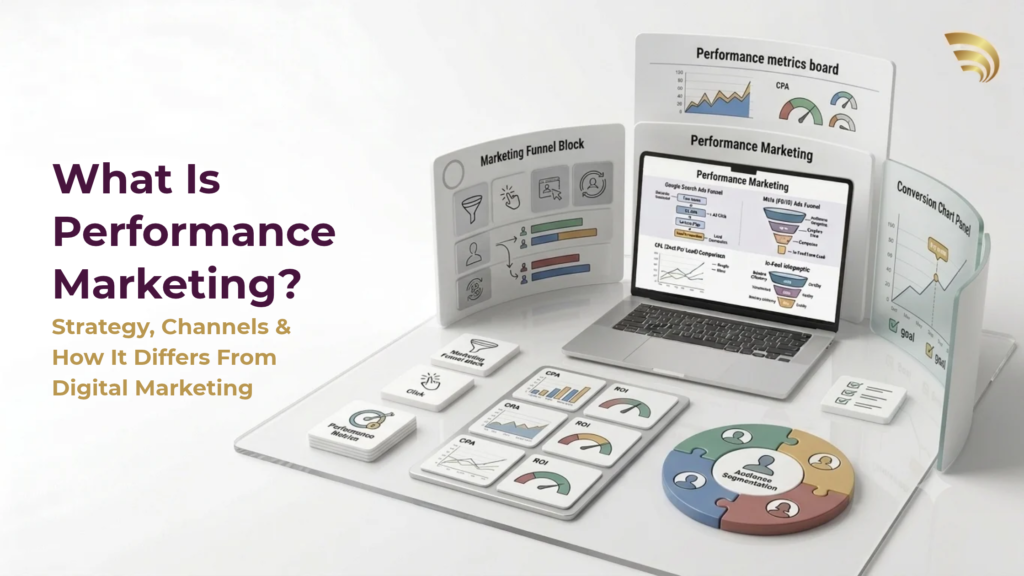
Performance marketing is a digital marketing approach focused on measurable actions such as leads, sales, applications, appointments, sign-ups, or other defined conversions. Instead of judging a campaign mainly by how many people saw an ad, businesses can connect marketing activity to what happened after the click.
That makes performance marketing particularly useful when the business needs to understand where its budget is going and whether campaigns are producing meaningful results. For education, healthcare, and fintech businesses, those results may look very different, but the principle remains the same: measure the action that matters to the business.
Table of Contents
Key Takeaways
- Performance marketing focuses on measurable actions, not just reach or visibility.
- A strong performance marketing strategy starts with the business goal, audience, and conversion journey.
- Google Ads, Meta Ads, LinkedIn Ads, affiliate marketing, native advertising, and other channels can support performance campaigns depending on the audience and objective.
- Performance marketing vs digital marketing isn’t an either-or comparison. Performance marketing is one results-focused part of the broader digital marketing mix.
- Low-cost clicks or leads don’t automatically mean a campaign is working. Lead quality, conversion rate, acquisition cost, and revenue matter.
- SEO and performance marketing serve different purposes and can work together when a business needs both immediate acquisition and long-term organic visibility.
What Is Performance Marketing?
Performance marketing is a results-focused form of digital marketing where campaigns are planned, tracked, and optimized around measurable actions. Depending on the business, that action could be a click, lead, application, purchase, appointment, app install, or another conversion. Performance marketing is an approach where payment can be tied to measurable actions such as CPC, CPL, CPA, or CPI.
The useful part is the connection between marketing activity and business outcomes. A school can measure qualified admission enquiries, a doctor can track appointment requests, and a fintech company can measure completed applications rather than stopping at ad impressions. That doesn’t mean every campaign should be judged only on immediate revenue; some campaigns have awareness or consideration goals. The point is to decide what success means before spending the budget and then use reliable data to evaluate it.
How Does Performance Marketing Work?
A practical performance marketing process looks like this:
Business goal → Target audience → Channel → Campaign → Landing page → Conversion → Measurement → Optimization
The process starts with the outcome, not the advertising platform. Once the goal is clear, marketers can choose the audience, channel, message, and conversion path that support it. Campaign data then shows what is working and where people are dropping out, allowing the team to test changes instead of relying on assumptions.
How to Build a Performance Marketing Strategy
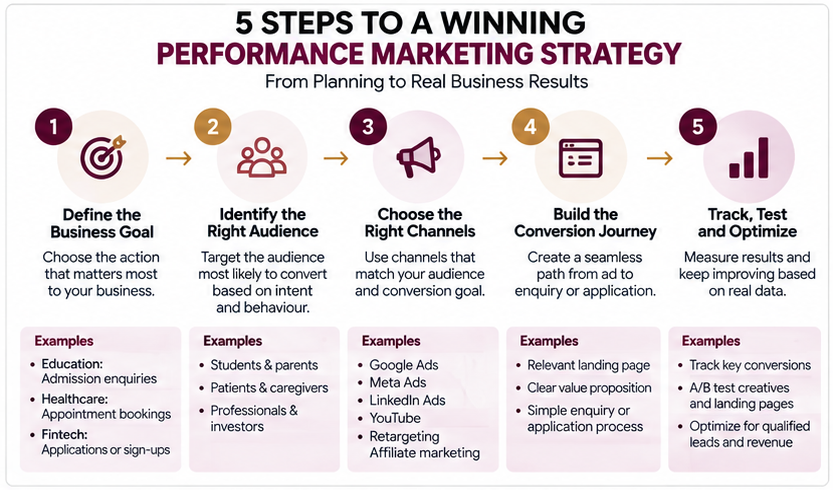
A performance marketing strategy should connect advertising decisions to a specific business outcome. The basic framework is straightforward: define the goal, understand the audience, choose the right channels, build the conversion journey, track results, and improve the campaign based on what the data shows.
1. Start With the Business Goal
Don’t start with “How much should we spend on Google Ads?” Start with “What do we need the campaign to achieve?”
For example:
- Education: qualified admission enquiries, campus visits or applications
- Healthcare: appointment enquiries or bookings
- Fintech: qualified applications, registrations or completed conversions
A campaign becomes much easier to evaluate once the desired action is clearly defined.
2. Identify the Right Audience
Audience selection affects everything that follows, from the platform and creative to the landing page and conversion target. An education campaign may need different messaging for parents, students, and working professionals, while a healthcare campaign may need to distinguish between people researching a condition and people actively looking for a doctor. In fintech, the audience may vary considerably depending on whether the product is aimed at consumers, businesses, investors, or another segment.
3. Choose Channels Based on Intent
The channel should fit the way your audience makes decisions.
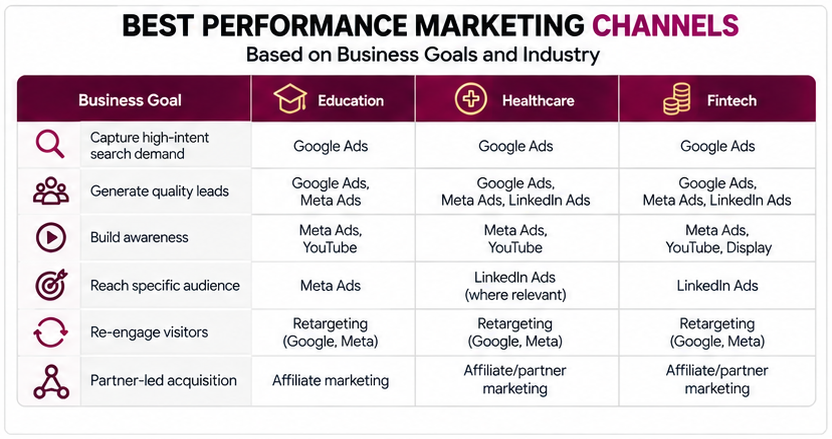
| Objective | Channels to consider |
| Capture existing search demand | Google Ads |
| Reach parents and students | Google, Meta, YouTube |
| Generate professional/B2B leads | Google, LinkedIn |
| Reach healthcare audiences | Google, Meta, LinkedIn where appropriate |
| Generate fintech leads | Google, Meta, LinkedIn |
| Re-engage previous visitors | Retargeting |
| Partner-led acquisition | Affiliate marketing |
There is no universal “best” performance marketing channel. A channel that works well for a high-intent search campaign may be less useful for creating initial awareness, and a channel that produces inexpensive leads may still be a poor choice if those leads rarely convert.
4. Build the Conversion Journey
Getting someone to click an advertisement is only the beginning. The landing page needs to match the promise made in the ad, make the next step clear, and remove unnecessary friction from the enquiry or conversion process. After that, the business needs a way to capture, qualify, and follow up with the lead so campaign performance can be measured beyond the first form submission.
5. Track, Test and Optimize
Performance marketing requires continuous optimization. Marketers must regularly audit creative performance, landing page conversion rates, targeting accuracy, and downstream lead quality. A/B testing can compare different creative, messages, or landing-page versions, while conversion tracking shows whether the changes improve results.
Which Performance Marketing Channels Should You Use?
Performance marketing can include paid search, social advertising, affiliate marketing, native advertising, influencer campaigns, and other channels where actions can be tracked. Affiliate marketing, search engine marketing, social advertising, and native advertising are among the common performance channels, while LinkedIn places particular emphasis on partner, publisher, creator, and social channels for B2B campaigns.
For Croccle, the practical choice often comes down to intent, audience, and conversion value. Education businesses may need a combination of search and social to reach people at different stages of the admission journey. Healthcare and fintech campaigns require even more attention to audience quality, trust, landing-page experience, and the specific action being measured.
What’s the Difference Between Performance Marketing vs Digital Marketing?
Understanding performance marketing vs digital marketing becomes easier when you look at what each term covers. Digital marketing is the broader category that includes activities such as SEO, content marketing, social media, email, paid advertising, and other online marketing methods. Performance marketing is more focused on measurable actions and campaign outcomes, although performance campaigns can sit inside a wider digital marketing strategy.
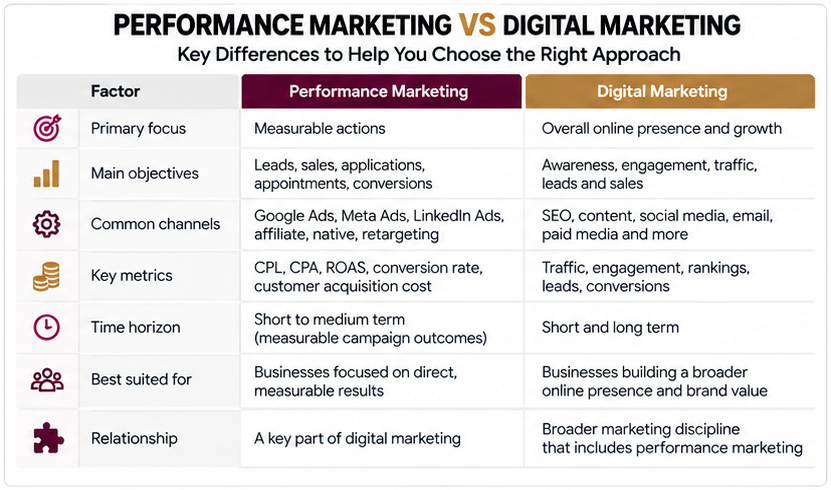
| Factor | Performance Marketing | Digital Marketing |
| Primary focus | Measurable actions | Overall online marketing |
| Common goals | Leads, sales, applications, conversions | Awareness, traffic, engagement, leads, and sales |
| Typical metrics | CPA, CPL, ROAS, conversion rate | Traffic, engagement, rankings, leads, conversions |
| Time horizon | Often focused on measurable campaign outcomes | Can support both short- and long-term goals |
| Examples | Google Ads lead campaign, affiliate campaign | SEO, content, social, email, paid media |
| Relationship | Part of the wider digital marketing mix | Broader marketing discipline |
Is Performance Marketing Part of Digital Marketing?
Yes. Performance marketing is best understood as a results-focused approach within the broader digital marketing ecosystem. A business can use SEO to build organic visibility, content to educate potential customers, social media to develop engagement, and paid campaigns to generate measurable conversions. These activities don’t have to compete with one another; they can support different parts of the same customer journey.
How Does Performance Marketing Work for Education, Healthcare and Fintech?
The basic model stays the same, but the conversion that matters changes significantly between industries.
Education
For schools, colleges and education brands, the journey might look like:
Search/Social Ad → Program or Course Page → Enquiry → Counselling → Application → Admission

A campaign that generates 2,000 enquiries isn’t necessarily successful if most of those enquiries are irrelevant or never progress. Education marketers should therefore look beyond CPL and examine lead quality, counselling outcomes, applications and admissions where those data points are available.
Healthcare and Doctors
A healthcare campaign may follow:
Search/Social → Doctor or Service Page → Appointment Enquiry → Booking → Consultation

Healthcare marketing needs careful attention to the accuracy and appropriateness of the information being promoted. A campaign should make it easy for someone to understand the service, doctor or appointment process without relying on exaggerated claims or misleading messaging.
Fintech
A fintech journey could look like:
Search/Social → Product Page → Lead/Application → Verification → Completed Conversion

Here, a large number of low-quality leads can quickly distort campaign performance. A better measure may be how many users complete the required application or qualification process and what those acquired customers are worth to the business.
Which Performance Marketing Metrics Should You Track?
The right performance marketing metrics depend on the campaign objective. A lead-generation campaign should not be judged the same way as an ecommerce campaign, and a healthcare appointment campaign has different commercial outcomes than an education admission campaign. LinkedIn lists conversion rates, clicks, leads, engagement, pageviews, and impressions among measurable performance indicators, while CPM, CPC, CPL, and CPA are important measurement and payment models.
| Metric | Full Form | What it tells you |
| CTR | Click Through Rate | How often people click after seeing the ad |
| CPC | Cost Per Click | What you are paying for each click |
| CPL | Cost Per Lead | What you are paying for each lead |
| CPA | Cost Per Acquisition | What it costs to acquire a defined action/customer |
| Conversion Rate | How effectively visitors complete the desired action | |
| ROAS | Return on Ad Spend | Revenue generated relative to advertising spend |
| CAC | Customer Acquisition Cost | Overall cost of acquiring a customer |
| LTV or CLV | Customer Lifetime Value | Expected value of a customer over the relationship |
| CPI | Cost Per Install | What you are paying for each mobile app installation |
One important distinction is often missed: cheap isn’t the same as effective. A ₹200 lead that never answers the phone may be less valuable than a ₹700 lead that becomes a paying customer. For Croccle’s focus industries, campaign reporting should therefore move beyond platform metrics and connect advertising data with the outcome the business actually cares about.
How to Fix Common Performance Marketing Problems?
Lots of Leads, Few Conversions
If the campaign generates enquiries but very few become customers, the problem may sit after the advertisement. Review the landing page, lead qualification, follow-up process, and sales or counselling journey before simply increasing the ad budget.
Cheap Leads With Poor Quality
A low CPL can look impressive in a weekly report while creating extra work for the sales team. Tighten targeting, review the message used in the advertisement, improve the qualification process, and optimize campaigns toward meaningful conversion events where the platform and tracking setup allow it.
High Clicks but Low Conversion
This usually calls for a closer look at the journey between the advertisement and the conversion. The ad may be attracting the wrong intent, the landing page may not answer the user’s question, or the next step may be unclear. Fixing the page or audience can sometimes matter more than changing the bid.
Campaign Performance Drops After a Strong Start
Audiences can become saturated, creative can lose attention, and market conditions can change. Instead of assuming the platform is simply “performing badly,” look at frequency, audience quality, search terms, creative fatigue, landing-page performance, and conversion data.
You Can’t Tell Which Channel Generates Revenue
This is usually a measurement problem. Make sure important conversion events are tracked consistently and that leads can be connected to later stages of the customer journey where possible. Without that connection, it becomes difficult to know whether you’re optimizing for business growth or simply optimizing what the advertising dashboard happens to report.
Performance Marketing vs SEO: When Should You Use Each?
The question “Which is better, SEO or performance marketing?” doesn’t have one answer for every business. Performance marketing can help a business buy targeted traffic and pursue measurable actions now, while SEO focuses on earning organic visibility that can continue bringing relevant visitors without paying for every click. The better choice depends on the business objective, competition, available resources, search demand, and how quickly results are needed.
For many businesses, the two work better together. A school can use paid search during an admission cycle while building SEO content that attracts parents throughout the year, and a fintech company can use paid campaigns for specific acquisition goals while developing organic content around financial questions. Healthcare brands can similarly combine search visibility with paid campaigns where the relevant advertising policies and regulations permit it.
| If the priority is… | Consider |
| Capturing immediate paid demand | Performance marketing |
| Building long-term organic visibility | SEO |
| Testing a new offer quickly | Performance marketing |
| Building a sustainable content asset | SEO |
| Covering both immediate and long-term demand | SEO + performance marketing |
The important thing is not to treat them as competing departments with completely separate goals. Search data from paid campaigns can reveal valuable demand patterns, while SEO can reduce dependence on paid acquisition for searches where organic visibility is achievable.
Must Read: Why SEO is Important for Educational Institutions?
How to Improve Performance Marketing Results
Start by looking at the whole conversion path, not just the advertisement. A strong creative cannot compensate for a confusing landing page, and a low CPC does not help if the resulting traffic never becomes a qualified enquiry or customer. Performance improves when the audience, message, landing page, tracking setup, and follow-up process work together.
Focus on these five areas:
- Improve audience targeting so the campaign reaches people with a realistic chance of converting.
- Match the landing page to the ad so visitors immediately find what they expected.
- Optimize for qualified conversions rather than chasing the highest possible lead volume.
- Test creative, messaging, and landing pages instead of making large changes based on assumptions.
- Connect campaign data to business outcomes so budget decisions are based on actual value.
That last point is especially important. Performance marketing becomes much more useful when the marketing team can explain not only how many leads a campaign generated, but what happened to those leads afterward.
How AI and Automation Are Changing Performance Marketing
AI and automation are increasingly being used for campaign optimization, creative variations, audience analysis, bidding, and reporting.
For marketers, the practical change is less about replacing the strategy and more about handling more campaign decisions at speed. A platform can test more variations or adjust bids quickly, but someone still needs to define the business goal, decide which conversion matters, check data quality, and judge whether the campaign is producing useful customers. That human layer matters even more when the business operates in areas such as healthcare, finance, or education, where accuracy, trust, and appropriate communication matter.
FAQs
Which is better, SEO or performance marketing?
Neither is universally better. Performance marketing is useful when a business needs measurable paid acquisition, while SEO is suited to building organic search visibility over time. Many businesses can use both, with performance marketing supporting immediate acquisition and SEO building longer-term demand.
What are the 5 key performance indicators in marketing?
Five widely useful KPIs are conversion rate, customer acquisition cost (CAC), cost per acquisition or lead (CPA/CPL), return on ad spend (ROAS), and customer lifetime value (LTV). The most useful combination depends on the campaign objective and business model.
Is performance marketing the same as digital marketing?
No. Digital marketing is the broader discipline covering online activities such as SEO, content, social media, email, and paid advertising. Performance marketing focuses more specifically on measurable actions and outcomes.
How does performance marketing work?
Performance marketing starts with a measurable business goal, identifies the relevant audience, selects appropriate channels, launches tracked campaigns, measures conversions, and continuously improves performance based on the results.
What are the main performance marketing channels?
Common channels include paid search, social advertising, affiliate marketing, native advertising, influencer campaigns, display advertising, and other trackable digital campaigns. The appropriate mix depends on the audience, objective, conversion journey, and economics.
Is performance marketing suitable for education, healthcare, and fintech?
Yes, but the strategy needs to reflect the industry’s customer journey and requirements. Education may focus on qualified admissions enquiries, healthcare on appropriate appointment-related actions, and fintech on qualified applications or conversions.
Conclusion
Performance marketing works best when the business knows exactly what it wants to achieve and has a reliable way to measure that outcome. The campaign shouldn’t stop at impressions, clicks or even leads; the real question is whether those activities are contributing to qualified enquiries, applications, appointments, customers or revenue. That requires the right audience, channel, creative, landing page, tracking and follow-up process.
For education, healthcare and fintech businesses, there is no single campaign formula that works across every situation. A useful performance marketing strategy starts with the business problem, chooses channels around customer intent, and keeps improving the journey based on evidence. When paired with SEO and other digital marketing activities, performance marketing can become one part of a broader acquisition strategy rather than a standalone advertising exercise.
About the Author
Dev Gupta (DG) is the Founder of Croccle, a digital growth consultancy helping businesses build a stronger online presence through branding, SEO, AI search optimisation, content strategy, social media, and performance marketing. With years of experience and a track record of working with 100+ brands across diverse industries, he shares practical insights to help businesses stay ahead in an evolving digital world.
Connect and follow him on LinkedIn.