
Choosing the right digital marketing agency for fintech in India can directly influence how many qualified leads, app users, investors, and customers your business attracts.
The challenge is that not every agency understands the financial technology sector. Fintech companies operate in one of the most competitive and regulated industries, where trust, compliance, security, and customer education matter as much as visibility. Whether you’re launching a payment platform, digital lending solution, wealth management app, insurtech platform, or B2B fintech SaaS product, your marketing partner needs to understand how people research financial products and what convinces them to convert.
That’s why selecting a fintech marketing agency goes beyond hiring someone who offers SEO or paid advertising. You need a partner that understands financial regulations, customer acquisition costs, AI-powered search, long buying cycles, and the importance of building credibility across every digital touchpoint.
This guide explains how to choose the best fintech digital marketing agency for business, the qualities you should prioritise, warning signs to avoid, and the questions to ask before signing an agreement.
Key Takeaways
- Choose an agency with proven fintech or financial services experience.
- Prioritise business outcomes such as qualified leads, customer acquisition, and ROI over rankings alone.
- Ensure your agency understands all core digital marketing channels.
- Look for clear reporting, technical expertise, and content that builds trust.
- Select a long-term marketing partner based on demonstrated results, not marketing promises.
Table of Contents
Why Do Fintech Businesses Need a Different Digital Marketing Strategy?
Fintech marketing is fundamentally different from marketing a retail store, restaurant, or general SaaS company. Financial decisions involve higher trust, stricter compliance, longer consideration periods, and greater customer expectations.
A successful Digital Marketing Agency for Financial Services understands these differences and builds campaigns around them rather than applying generic marketing tactics.
1. Financial Decisions Depend on Trust
People don’t download a banking app or apply for a loan because of a clever advertisement alone. They need confidence that the company is legitimate, secure, and reliable. Before becoming a customer, users often check:
- Google reviews
- App Store ratings
- Industry recognition
- Security certifications
- Media mentions
- Customer testimonials
- Website quality
- Educational resources
Your marketing should strengthen these trust signals instead of focusing only on generating clicks.
2. Customer Journeys Are Longer
Unlike ordering food online, choosing a financial product usually takes time. A customer may compare providers, read reviews, research pricing, evaluate security, check regulations, seek recommendations, and ask AI assistants for advice.
Your marketing strategy needs to support every stage of this journey. That means combining SEO, content marketing, paid advertising, email nurturing, reputation management, and conversion optimisation into one cohesive strategy.
3. Regulations Shape Your Marketing
Financial services operate within regulatory frameworks. Whether you’re promoting lending, insurance, investments, payments, or wealth management, your campaigns need to communicate clearly without making misleading claims.
An experienced financial services marketing company understands the importance of compliant messaging, accurate content, transparent offers, appropriate disclaimers, and trustworthy user experiences. This reduces risk while strengthening customer confidence.
4. AI Search Is Changing Customer Research
Many customers no longer rely solely on Google Search. Instead, they ask conversational questions like:
- Which payment gateway is best for Indian startups?
- What’s the safest investment app?
- Which fintech company offers low-cost international payments?
- Which digital lender has the fastest approval process?
Google AI Overviews, ChatGPT, Gemini, Claude, and Perplexity increasingly answer these questions by summarising trusted sources instead of displaying only links. Your marketing strategy should prepare your brand for both traditional search and AI-powered discovery.
5. Competition Is Increasing Across Every Fintech Category
India’s fintech ecosystem continues to expand rapidly. According to government and industry reports, India has become one of the world’s largest fintech markets by number of companies and digital payment adoption. Whether your business focuses on:
- Digital payments
- Lending
- Insurance technology
- WealthTech
- RegTech
- Personal finance
- Embedded finance
- B2B financial software
you’re competing against established brands with significant marketing investments. Standing out requires more than publishing occasional blog posts.
6. Success Should Be Measured by Revenue, Not Traffic
Higher website traffic doesn’t always translate into business growth. A specialist digital marketing agency for fintech focuses on meaningful business outcomes such as:
- Qualified leads
- Customer acquisition
- App downloads
- Product sign-ups
- Demo requests
- Cost per acquisition (CPA)
- Customer Lifetime Value (CLV)
- Return on Marketing Investment (ROMI)
These metrics provide a clearer picture of marketing performance than rankings alone.
What Should Fintech Businesses Look for in a Digital Marketing Agency in India?
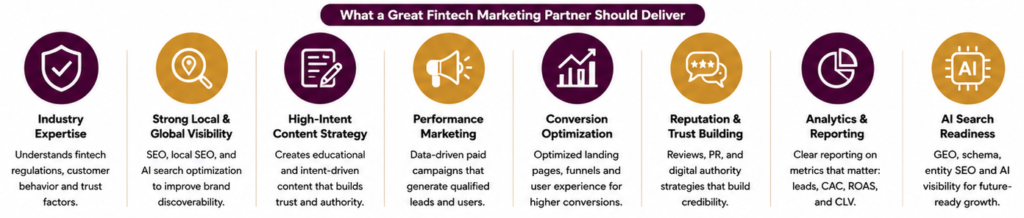
Many agencies advertise SEO, Google Ads, or social media management. Far fewer understand how fintech customers think, how financial products are purchased, and how AI-powered search is changing online discovery.
If you’re evaluating agencies, these are the qualities that deserve the closest attention.
1. Industry Experience Matters
A good agency understands marketing. A great fintech agency understands finance. An experienced fintech marketing agency already knows the challenges surrounding customer trust, regulatory communication, investor audiences, financial terminology, long buying cycles, and security concerns.
Instead of spending months learning your industry, they can develop strategies based on proven experience. Ask for examples of previous work within fintech or related financial services.
2. Strong Understanding of Organic Search
Many fintech journeys begin with a search. Users search for:
- Best expense management software
- Business loan for startups
- Digital banking solutions
- Online investment platform
- GST invoicing software
A capable fintech SEO agency should understand topical authority, content clustering, technical SEO, entity optimisation, internal linking, search intent, and local SEO where applicable.
The goal isn’t simply higher rankings. It’s becoming the trusted answer customers find during their research.
3. Compatibility With AI Search
Traditional SEO is no longer enough. Customers increasingly ask AI assistants questions instead of typing short keywords into search engines.
For example:
“What’s the best fintech platform for SME lending in India?”
or
“Recommend secure payroll software for growing businesses.”
Instead of presenting ten search results, AI systems often recommend only a handful of businesses.
Ask whether the marketing agency understands:
- AI SEO
- Generative Engine Optimisation (GEO)
- Entity SEO
- AI visibility audits
- structured data
- AI citation strategies
An agency that ignores AI search today may leave your business less visible tomorrow.
4. A Keyword Strategy Built Around Customer Intent
Successful digital marketing in finance industry starts with understanding why people search. An experienced agency separates informational searches from transactional intent.
For example:
| Informational Search | High-Intent Search |
| What is digital lending? | Apply for business loan online |
| What is UPI? | Best payment gateway for startups |
| How does investment work? | Open Demat account online |
| Fintech trends | Accounting software demo |
The second group usually generates stronger commercial opportunities. An effective strategy targets both educating future customers while capturing those ready to take action.
5. Transparent Reporting That Connects Marketing to Business Growth
Marketing reports shouldn’t feel like technical documents. Your agency should explain performance using metrics that matter to your business. Look for reporting that includes:
- Qualified leads
- Customer acquisition cost
- Organic visibility
- Paid campaign performance
- Conversion rate
- Revenue attribution
- Return on ad spend (ROAS)
Clear reporting allows you to understand where your investment is delivering results.
6. Content That Builds Trust
Fintech customers often need education before making decisions. Your marketing partner should create content that answers genuine customer questions rather than publishing articles purely for search rankings. High-performing fintech content often includes:
- Buying guides
- Product comparisons
- Compliance explainers
- Industry insights
- Security best practices
- Frequently asked questions
- Case studies
- Expert commentary
This approach supports both SEO and customer confidence.
7. A Website Designed for Conversions
Your website shouldn’t simply look modern. It should make taking the next step easy. A well-designed fintech website typically includes:
- Fast loading speeds
- Mobile-first design
- Clear navigation
- Secure browsing
- Simple forms
- Visible trust badges
- Product-specific landing pages
- Strong calls to action
Every page should reduce friction while answering customer questions.
8. Reputation Management Should Be Part of the Strategy
Financial services rely heavily on credibility. Your marketing agency should help monitor and strengthen your online reputation through customer review strategies, media mentions, third-party listings, thought leadership, customer testimonials, and industry recognition.
Strong reputation signals influence both search engines and AI-generated recommendations.
9. A Team That Explains Marketing Clearly
Marketing shouldn’t feel like learning a new language. Choose an agency that explains:
- what they’re doing
- why they’re doing it
- expected outcomes
- performance metrics
- next steps
If every conversation is filled with buzzwords instead of practical advice, communication may become difficult over the long term.
10. Flexible Partnerships Instead of Restrictive Contracts
Results should keep clients, not contracts. Many businesses evaluating the best fintech digital marketing agency for business in India prefer partners that focus on long-term performance rather than locking clients into lengthy commitments.
A confident agency is usually willing to demonstrate value consistently through measurable outcomes.
What Should Your Evaluation Checklist Include?
Before choosing a Digital Marketing Agency for Financial Services, compare potential partners against these criteria.
| Evaluation Area | What to Look For |
| Fintech Experience | Demonstrated success with fintech or financial brands |
| SEO Expertise | Technical SEO, topical authority, entity optimisation |
| AI Search Readiness | GEO, AI SEO, AI visibility optimisation |
| Content Quality | Expert-led, compliant, customer-focused |
| Reporting | Business metrics, not vanity metrics |
| Website Optimisation | Speed, UX, security, conversion focus |
| Reputation Management | Reviews, PR, trust-building strategies |
| Communication | Clear explanations and proactive support |
| Flexibility | Performance-driven partnerships |
How Can You Tell If an Agency Is the Right Fit?
Before signing any agreement, ask yourself these questions:
- Do they understand how people choose financial products?
- Can they explain their strategy in plain language?
- Have they worked with fintech businesses before?
- Do they prepare brands for AI-powered search?
- Will they measure business outcomes rather than just traffic?
- Do they understand both compliance and customer psychology?
If the answer to most of these questions is yes, you’re likely speaking with an agency that understands fintech rather than simply selling marketing services.
What Questions Should You Ask Before Hiring a Fintech Marketing Agency in India?
Choosing an agency based on pricing or promises of first-page rankings rarely leads to long-term success. Instead, evaluate how the agency approaches strategy, compliance, reporting, and sustainable growth. Here are some questions worth asking before making your decision.
“Have You Worked With Fintech or Financial Services Companies Before?”
Industry experience shortens the learning curve. An agency that has worked with fintech businesses already understands customer acquisition challenges, regulatory considerations, and the importance of trust. Ask for:
- Relevant case studies
- Industries served
- Results achieved
- Client testimonials
“How Will You Generate Qualified Leads Instead of Just Website Traffic?”
More traffic isn’t always better. A strong digital marketing agency for fintech should explain how they’ll attract users who are genuinely interested in your products or services. Their strategy should include:
- Search intent research
- Landing page optimisation
- Conversion tracking
- Lead nurturing
- Remarketing campaigns
“How Will Success Be Measured?”
Marketing reports should connect directly to business growth. Instead of focusing only on rankings or impressions, ask how they’ll measure:
- Qualified leads
- Customer acquisition cost (CAC)
- Cost per lead (CPL)
- Conversion rate
- Return on advertising spend (ROAS)
- Customer Lifetime Value (CLV)
These metrics provide a clearer picture of marketing performance.
“How Are You Preparing Clients for AI Search?”
Search behaviour is changing quickly. Customers increasingly ask conversational questions through:
- Google AI Overviews
- ChatGPT
- Gemini
- Claude
- Perplexity
Ask whether the agency offers:
- AI Visibility Audits
- Generative Engine Optimisation (GEO)
- Entity SEO
- AI-ready content strategy
- Structured data implementation
Businesses that prepare for AI search today are likely to remain more visible as search continues to evolve.
“Will I Understand What You’re Doing?”
A reliable agency explains its recommendations clearly. If every meeting feels filled with technical jargon, you’ll struggle to understand where your marketing budget is going.
Good partners educate clients instead of confusing them.
“Are There Long-Term Contracts?”
Performance should build long-term relationships. Many businesses prefer agencies that retain clients because they deliver consistent value rather than relying on restrictive contracts. Always understand:
- Contract duration
- Notice period
- Ownership of assets
- Reporting frequency
- Exit process
before signing.
How Much Does a Digital Marketing Agency for Fintech Charge in India?
There isn’t a fixed price for fintech marketing services because every business has different goals, competition, and growth plans.
A startup launching its first product will require a different strategy than an established financial platform expanding into multiple markets.
Your investment often depends on factors such as:
- Business size
- Target audience
- Geographic reach
- Marketing channels
- Competition
- Product complexity
- Growth objectives
A typical fintech marketing strategy may include:
- Technical SEO
- Content marketing
- AI SEO and GEO optimisation
- Google Ads
- LinkedIn advertising
- Performance marketing
- Email marketing
- Conversion Rate Optimisation (CRO)
- Reputation management
- Analytics and reporting
Rather than asking,
“What’s the cheapest package?”
ask,
“What level of investment will help us reach our business goals efficiently?”
The lowest-cost option often delivers the lowest return if it fails to generate qualified customers.
Why Businesses Choose Croccle for Fintech Digital Marketing
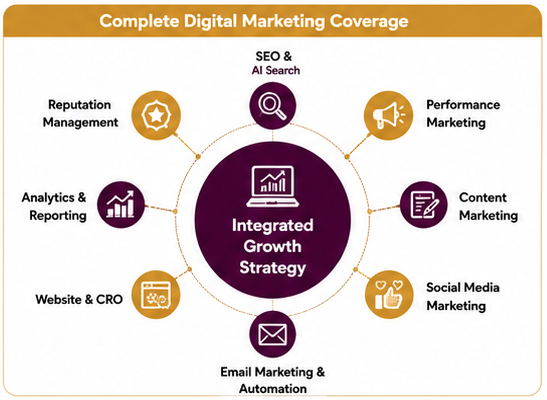
Croccle helps fintech businesses grow through integrated digital marketing strategies that combine SEO, AI Search Optimisation, paid media, content marketing, social media, analytics, conversion optimisation, and marketing automation. Rather than treating every marketing channel separately, we build connected strategies that attract qualified customers, improve conversions, and support sustainable business growth.
Here are a few reasons fintech businesses choose Croccle.
1. Strong Client Relationships Built on Results
The strongest agency relationships are built on measurable outcomes and consistent communication.
Croccle works closely with clients through regular strategy reviews, performance reporting, and continuous campaign optimisation. Our goal is to become an extension of your team, helping you make informed marketing decisions rather than simply delivering monthly reports.
Croccle maintains a 94% client retention rate, reflecting our commitment to long-term partnerships, measurable results, and proactive support.
2. Digital Marketing Built for Today’s Search Experience
Customer discovery now happens across multiple platforms, not just Google Search. Croccle combines traditional digital marketing with strategies designed for AI-powered search experiences, helping fintech brands improve visibility across:
- Google Search
- Google AI Overviews
- ChatGPT
- Gemini
- Claude
- Perplexity
- Meta
- YouTube
Our integrated approach combines:
- SEO
- AI Search Optimisation (GEO & AEO)
- Performance Marketing
- Content Marketing
- Digital PR
- Social Media Marketing
- Conversion Rate Optimisation (CRO)
- Marketing Automation
This creates a consistent customer journey across every digital touchpoint.
Must Read: How to check AI Visibility Score
3. Data, Analytics and Intelligent Marketing Insights
Successful marketing depends on accurate data. Croccle continuously monitors campaign performance to identify opportunities for improving visibility, conversions, and customer acquisition.
Our reporting focuses on meaningful business metrics, including:
- Qualified Leads
- Customer Acquisition Cost (CAC)
- Cost per Lead (CPL)
- Conversion Rate
- Return on Ad Spend (ROAS)
- Customer Lifetime Value (CLV)
Businesses receive clear insights that help connect marketing investment with business outcomes.
4. Full-Funnel Customer Acquisition Strategy
Generating traffic is only one part of the marketing process. Croccle builds strategies that support every stage of the customer journey from awareness and consideration to conversion and customer retention. This includes:
- Brand positioning
- Organic search
- Paid advertising
- Social media campaigns
- Educational content
- Landing page optimisation
- Email nurturing
- Conversion optimisation
- Customer retention strategies
Every channel works together to support sustainable growth.
5. Continuous Optimisation Based on Real Performance
Digital marketing isn’t static. Campaigns are reviewed regularly using performance data, user behaviour, and changing market trends to improve results over time.
This ongoing optimisation helps businesses reduce acquisition costs, improve campaign efficiency, increase conversion rates, identify new growth opportunities, and adapt to evolving customer behaviour.
6. Proven Strategies Designed for Long-Term Growth
Successful fintech marketing requires more than isolated campaigns. Croccle combines strategic planning, technical expertise, creative execution, and continuous optimisation to help businesses strengthen their digital presence and compete in an increasingly AI-driven search environment.
Whether your goal is to generate more qualified leads, increase product adoption, improve customer retention, or expand into new markets, our strategies are designed to support measurable business growth.
Frequently Asked Questions
How much does a digital marketing agency for fintech charge in India?
The typical cost ranges from ₹20,000 to ₹1,50,000+ per month. Costs vary based on your goals, competition, and marketing channels. Most fintech businesses invest according to growth objectives rather than fixed packages.
Is fintech in demand in India?
Yes. India’s fintech sector continues to grow rapidly, driven by digital payments, online banking, lending, and financial inclusion initiatives.
Is digital marketing for fintech still in demand in 2026?
Yes. As competition increases, fintech companies continue to invest in digital marketing to acquire customers, build trust, and improve brand visibility.
Is AI replacing digital marketing?
No. AI supports research, automation, and optimisation, but strategy, creativity, and business decisions still require human expertise.
Is digital marketing still worth it in 2026?
Absolutely. Businesses still rely on digital marketing to reach customers across search engines, AI platforms, social media, paid advertising, email, and other digital channels.
Conclusion
Choosing the right digital marketing agency for fintech isn’t simply about hiring a digital marketing service provider or advertising specialist. It’s about finding a partner who understands financial products, customer trust, compliance requirements, AI-powered search, and the metrics that drive sustainable business growth.
The best agencies don’t focus solely on rankings or traffic. They help you attract qualified prospects, improve conversion rates, strengthen your digital authority, and prepare your brand for the future of search.
As customer behaviour continues to evolve, businesses that invest in trusted content, strong digital entities, and measurable marketing strategies will be in a stronger position to compete both in search results and in AI-generated recommendations.
Croccle helps fintech brands grow through integrated digital marketing strategies tailored to today’s AI-first world. We combine SEO, AI Search Optimisation, performance marketing, content marketing, social media, conversion rate optimisation, analytics, and marketing automation to attract qualified customers and drive measurable business growth. Contact Croccle today to accelerate your fintech growth with data-driven digital marketing services in India.
About the Author
Dev Gupta (DG) is the Founder of Croccle, a digital growth consultancy helping businesses build a stronger online presence through branding, SEO, AI search optimisation, content strategy, social media, and performance marketing. With years of experience and a track record of working with 100+ brands across diverse industries, he shares practical insights to help businesses stay ahead in an evolving digital world.
Connect and follow him on LinkedIn.