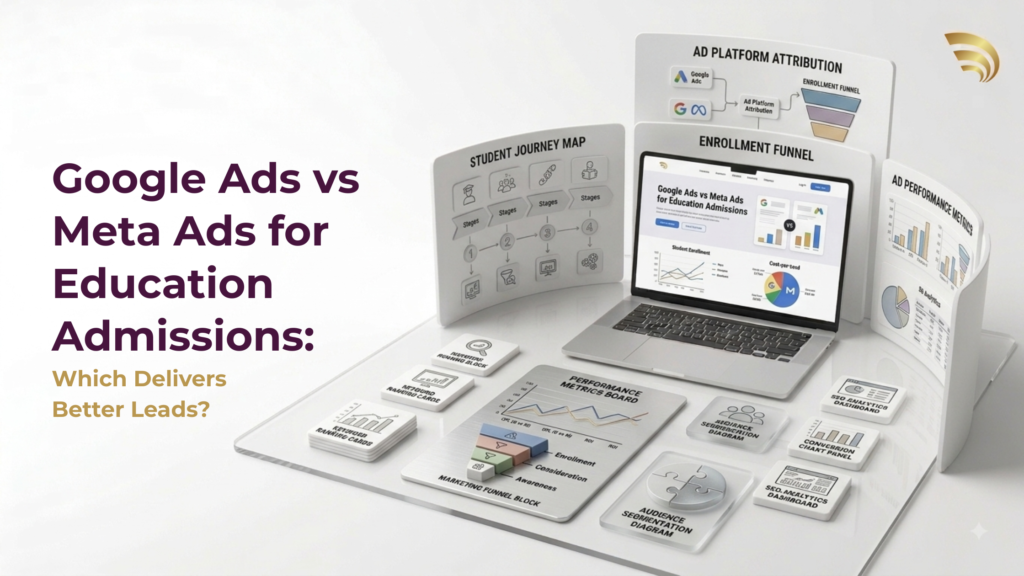
When comparing Google Ads for education with Meta Ads for education, there is no universal winner. Google Ads generally captures existing search intent, while Meta Ads helps institutions create awareness, reach relevant audiences, and generate demand through visual content, lead forms, and retargeting.
For a school, college, or university, the better approach is usually to use both at different stages of the admissions journey and judge them by qualified leads, campus visits, and admissions—not CPL alone.
Key Takeaways
- Social media should support the student journey from awareness and research to enquiry and application.
- Choose platforms based on your audience and goals, rather than trying to be active everywhere.
- Authentic student, faculty, campus, and alumni content builds trust better than constant promotional posts.
- Create content around real student and parent questions, including courses, admissions, fees, careers, and campus life.
- Connect social media with relevant landing pages and clear CTAs so engagement can turn into enquiries and applications.
- Measure meaningful business outcomes—not just followers and likes—including enquiries, registrations, campus visits, and applications.
Table of Contents
Quick Answer: Google Ads or Meta Ads for Education?
If a parent is already searching for a school, Google usually deserves attention first. If that same parent has never heard of your school, Meta can help you get on their radar. For colleges and universities, the same pattern applies: Google catches active demand, while Meta can create interest around programmes, campus life, placements and student experiences.
Google describes Search campaigns as a way to reach people actively searching for products or services, including through keyword-based targeting. Meta, meanwhile, offers campaign objectives for awareness, traffic, engagement and leads, allowing advertisers to reach people across Facebook, Instagram and Messenger based on the desired action.
So, if you’re asking for the best ad platform for education, the answer depends on the stage of the student journey.
| Objective | Better starting point | Why |
| Capture active admission searches | Google Ads | Reaches people searching for relevant terms |
| Local school admissions | Google Ads | Useful for location and search-intent campaigns |
| Build awareness for a new institution | Meta Ads | Strong visual and audience-based reach |
| Showcase campus and culture | Meta Ads | Instagram and Facebook suit visual storytelling |
| Promote a specific university programme | Google Ads + Meta | Captures intent while building demand |
| Retarget interested prospects | Google + Meta | Reconnect with previous visitors and engaged audiences |
| Generate enquiry volume | Both | Different platforms capture different types of demand |
Realistic Cost & Conversion Benchmarks: What to Expect
While specific campaign performance varies by region, target demographic, and course fee structure, understanding industry averages helps set realistic expectations for your ad spend:
| Metric | Google Ads (Search) | Meta Ads (FB/IG/WhatsApp) |
| Avg. Cost Per Click (CPC) | High (₹15–₹350 / $1.50–$4.50+) | Low (₹2–₹25 / $0.15–$0.80) |
| Avg. Cost Per Lead (CPL) | Higher (₹400–₹1,200+ / $30–$80+) | Lower (₹80–₹350 / $8–$25) |
| Lead-to-Applicant Conversion | High (12% – 25%) | Moderate to Low (2% – 8%) |
| Primary Ad Objective | High-intent Search, PMax | Instant Forms, WhatsApp Ads, Video Reels |
| Typical Decision Cycle | Fast (7 to 30 Days) | Longer Nurturing (30 to 90+ Days) |
Key Takeaway: Meta Ads consistently deliver a lower initial Cost Per Lead (CPL), making them ideal for building a massive top-of-funnel database. However, Google Ads target high-intent searchers actively looking for an institution, which translates to higher conversion rates and a lower overall Cost Per Admission (CPA).
Why Does Intent Matter in Education Advertising?
The core difference is intent: Google captures active demand when parents search for a school, while Meta creates demand by introducing your institution to passive scrollers.
Consider a parent searching for “best CBSE school near me” or “school admission 2027 in Pune.” That person has already expressed an educational need through a search query. Google Ads can place a relevant school advertisement alongside search results when the campaign’s keywords and targeting match the query.
Meta works differently. A parent may be scrolling through Instagram and see a short campus tour, student achievement, or admissions campaign without having searched for a school at that moment. Meta’s own advertising documentation describes awareness campaigns as a way to expand reach and keep a business present with relevant audiences, while its lead-generation products can capture enquiries through forms, messaging or calls.
In simple terms, the two ad platforms are doing different jobs:
- Google = capture existing demand.
- Meta = create, develop and recapture demand.
For education lead generation, understanding that distinction is more useful than asking which platform has the cheapest click.
What Works Best With Google Ads for Education?
Google Ads for education excels when search intent already exists. A parent searching for ‘CBSE school near me’ or a student querying ‘MBA college in Mumbai’ is significantly closer to an admissions decision than a passive user watching social media video reels.
For Schools
A school can build campaigns around searches such as:
- best school near me
- CBSE school admissions
- nursery admission in [city]
- international school in [city]
- school admission [year]
- best school in [locality]
Local targeting is especially useful when families are unlikely to travel long distances for a school. Google Ads allows advertisers to specify locations and location-related options, which can help institutions control where campaigns appear.
For Colleges
Google Ads for college admissions can focus on programme and course intent, such as MBA, BBA, engineering, law or other specific programmes. A search such as “MBA college in Mumbai” provides considerably more information about the user’s immediate need than a generic demographic profile alone.
For Universities
University campaigns can segment demand by programme, location, qualification and admissions stage. Google also supports conversion-focused campaign objectives, making it possible to optimise campaigns around lead actions rather than simply website traffic.
The important part is the landing page. A search for “MBA in Finance admissions” should lead to a page that answers questions about that programme, not a generic university homepage.
What Works Best With Meta Ads for Education?
Meta Ads for education are particularly effective when visual storytelling, audience discovery, engagement and lead capture are important. Instagram and Facebook give schools, colleges and universities space.
A 20-second campus video can show the library, sports facilities, classrooms or student activities before someone ever fills out an enquiry form. For a school, that might mean showing parents what a normal day looks like. For a college, it could mean giving a prospective student a feel for campus life.
For Schools
Schools can use campus tours, classroom activities, student achievements, sports, arts, parent stories and events to build familiarity before families begin actively comparing schools.
For Colleges
Colleges can promote student life, clubs, placements, faculty, infrastructure, events and programme experiences through video and carousel formats. These assets can help students understand the personality of a college before they enquire.
For Universities
Universities can use Meta for programme awareness, student testimonials, research stories, campus content, webinars and admissions campaigns. Meta also supports lead ads using instant forms, messaging and calls, which can reduce the number of steps between seeing an advertisement and expressing interest.
Meta’s current targeting system allows advertisers to use audience information such as location, age, interests and custom audiences, while its Advantage+ audience can expand beyond audience suggestions when the system predicts that doing so may improve performance.
Google vs Meta Ads for Education: Which Produces Better Leads?
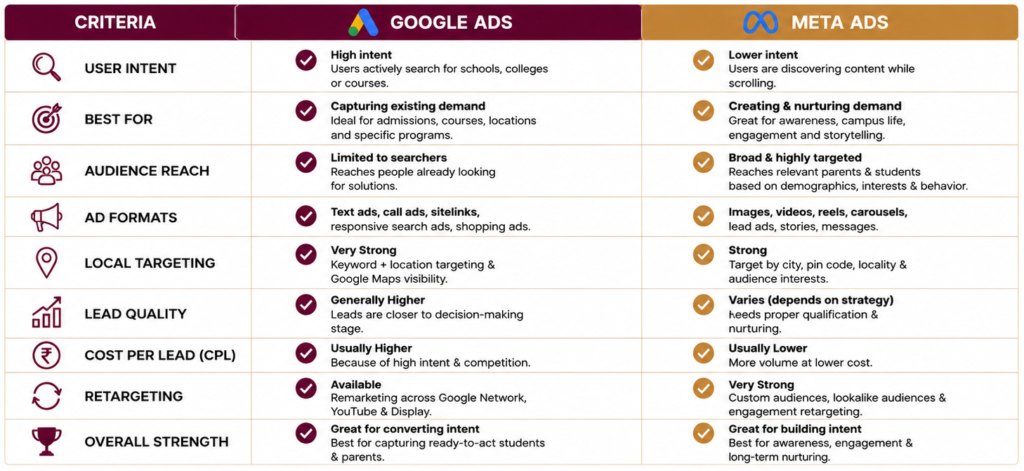
Google often has an advantage when lead quality depends heavily on active intent; Meta can produce useful lead volume when awareness and audience discovery are important.
Here’s where many education marketers get stuck. They compare the number of leads and immediately declare a winner. But imagine Meta gives you 200 enquiries and Google gives you 70. If the 70 Google leads contain far more parents or students who actually meet your admission criteria, the bigger number doesn’t mean much. Lead volume is only the first part of the story.
The one frames Google around intent and Meta around discovery, while the other recommends using both platforms across the admissions journey. That is a useful planning framework, but the budget percentages and CPL figures in those articles should be treated as campaign-specific guidance rather than universal industry benchmarks.
A practical comparison looks like this:
| Factor | Google Ads | Meta Ads |
| User intent | Higher when using relevant Search queries | Often lower at first exposure |
| Demand creation | Limited in Search | Strong |
| Visual storytelling | Limited in Search | Strong |
| Local school search | Strong | Useful for awareness and retargeting |
| Programme-specific demand | Strong | Strong for discovery |
| Lead forms | Available through Google lead-generation formats | Strong native lead-form and messaging options |
| Retargeting | Available across Google’s advertising ecosystem | Strong retargeting options |
| Campus/culture promotion | Secondary role | Strong |
| Lead volume | Can be constrained by search demand | Can expand reach beyond existing searchers |
| Lead qualification | Often helped by search intent | Requires stronger qualification and nurturing |
What this means in practice: a cheap lead does not automatically mean a better lead, and an expensive lead does not automatically mean a more profitable lead.
How Should Schools, Colleges and Universities Allocate Budget?
Budget allocation should follow demand, admissions timing, and lead quality rather than a fixed percentage copied from another institution.
A standard starting budget allocation during peak admissions is 60% Google Search, 30% Meta, and 10% YouTube/Display for school admissions, while another suggests a Meta-heavy approach for newer institutions and a Google-heavy approach for premium or established brands.
Those figures are useful as starting hypotheses, not guaranteed formulas. A useful way to approach this is:
| Institution situation | Starting approach |
| New school with low brand awareness | More Meta for awareness + Google for existing demand |
| Established school | Balance Google Search with Meta retargeting and awareness |
| Premium school with strong search demand | Greater Google emphasis |
| New college programme | Meta awareness + Google programme-intent campaigns |
| Established university | Google for programme demand + Meta for discovery and remarketing |
| Highly competitive admissions season | Protect high-intent Google campaigns while maintaining Meta remarketing |
We also recommend beginning awareness activity before the peak admission period rather than waiting until the busiest months. That principle makes sense: build familiarity first, then capture active demand when search behaviour increases.
How Does the Education Admissions Funnel Work Across Google and Meta?
The strongest education lead generation strategy treats Google and Meta as connected parts of the same journey. A prospective student may first discover an institution on Instagram, later visit its website, compare alternatives, and eventually search for the institution or programme on Google.
A practical journey looks like this:
Awareness → Research → Comparison → Intent → Enquiry → Visit → Application → Admission
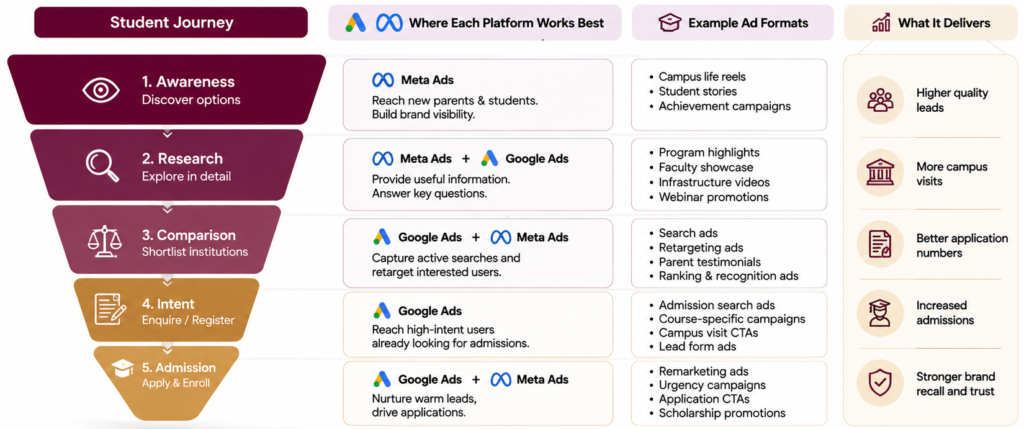
Meta can play a major role during awareness and research through campus content, student stories, programme videos and testimonials. Google can become increasingly important when the prospect starts searching for specific programmes, schools, fees, admissions or locations.
Both platforms can also support remarketing. Google provides remarketing options across Display and other Google properties, while Meta offers custom audiences and lead-generation options that allow institutions to reconnect with people who have interacted with their business.
This is why education lead generation shouldn’t be evaluated by the first form submission alone. The real question is whether the lead moves through the admissions funnel.
How Can Institutions Improve Lead Quality From Both Platforms?
Lead quality improves when advertising, landing pages, qualification, and follow-up work as one system.
Getting the lead is only half the job. I’ve seen this become a problem in education campaigns: the marketing team celebrates when the enquiry count goes up, while the admissions team is left dealing with people who aren’t eligible, aren’t from the right location, or never intended to apply. Better targeting helps, but so does asking the right questions on the form and making sure someone follows up quickly.
Start by separating leads according to meaningful criteria such as:
- Programme or class
- Location
- Admission year
- Eligibility
- Budget or fee category where appropriate
- Campus preference
- Stage of decision
- Requested intake
Google campaigns should use relevant search themes and negative keywords to reduce irrelevant traffic. Meta campaigns should use appropriate audience signals, creative, and qualification questions rather than chasing the maximum number of inexpensive forms.
Meta specifically recommends connecting lead-generation campaigns to CRM systems so new leads can be accessed and followed up quickly. Its documentation also provides options for forms, messaging, and calls.
That matters because lead speed is a sales-process issue, not just an advertising issue.
What Should Education Institutions Measure?
Cost per lead is easy to report, which is probably why it gets so much attention. But a low CPL can look great in a marketing report and still mean very little to the admissions team. If most of those enquiries don’t qualify, the campaign isn’t doing its real job. For education, you need to follow the lead beyond the form submission. Track:
- Cost per click
- Click-through rate
- Cost per lead
- Qualified-lead rate
- Lead-to-counselling rate
- Lead-to-campus-visit rate
- Visit-to-application rate
- Application-to-admission rate
- Cost per admission
- Revenue or tuition value generated
For example, suppose Meta produces 300 leads at a lower CPL, and Google produces 100 leads at a higher CPL. If 20% of Google’s leads become qualified applicants while only 4% of Meta’s leads qualify, the cheaper Meta campaign isn’t necessarily the better campaign.
This is the distinction between lead generation and profitable education lead generation.
Technical Infrastructure: Connecting Click Data to Admissions
High lead volume means little if your admissions team cannot follow up before intent cools down. A successful performance campaign requires three technical foundations:
- Server-Side Tracking (Meta CAPI & Google Enhanced Conversions): Browser-based tracking pixel accuracy has degraded due to privacy changes (such as iOS ATT). Implementing Meta Conversions API (CAPI) and Google Enhanced Conversions ensures accurate attribution and trains ad algorithms on true conversion signals.
- Instant CRM Integration: Route Meta Instant Form and Google Search leads directly into an admissions CRM (such as LeadSquared, HubSpot, or Salesforce) in real time. Leads contacted within the first 15 minutes convert at up to 3x higher rates than those contacted after 24 hours.
- Offline Conversion Imports (OCI): Feed downstream admissions milestones (e.g., “Application Submitted,” “Fee Paid”) back into Google and Meta. This shifts algorithmic optimization from “cheap leads” to “high-intent applicants.”
What Are the Common Mistakes in Google and Meta Education Advertising?
Most poor-performing education campaigns fail because the institution optimises the advertising platform without fixing the rest of the admissions funnel. Common mistakes include:
- Sending every advertisement to the homepage
- Using generic “Admissions Open” messaging
- Targeting an unnecessarily large geographic area
- Running broad keywords without reviewing search terms
- Ignoring negative keywords in Google campaigns
- Treating every Meta lead as equally valuable
- Using the same creative for every audience
- Launching only during peak admission periods
- Failing to retarget interested visitors
- Measuring CPL without tracking admissions
- Taking too long to contact new enquiries
- Using unsupported performance benchmarks as guarantees
Based on our expertise, also emphasise landing pages, retargeting, campaign timing and follow-up. Those are sensible areas to audit before simply increasing ad spend.
What Is the Best Ad Platform for Education?
There is no single best ad platform for education. Google is usually the stronger first choice for high-intent searches, while Meta is often the stronger first choice for awareness, visual storytelling and demand creation.
For a school, Google can capture parents already searching for nearby schools while Meta keeps the institution visible through campus and student-life content. For a college or university, Google can capture programme-specific demand while Meta introduces programmes to students who may not yet have decided what or where to study.
For that reason, the best Google vs Meta Ads for education strategy is usually an integrated one rather than a platform battle.
If your institution doesn’t have an in-house performance marketing team, working with experienced top education lead generation companies can help manage campaign strategy, audience targeting, creative testing, landing pages and lead tracking. The right education lead generation services should focus on qualified enquiries and admissions outcomes, not simply delivering a high number of low-cost leads.
Must Read: Why Google Ads for educational institutions gives the best leads?
FAQs About Google Ads vs Meta Ads for Education
Are Google Ads better or Meta Ads?
Google Ads is generally better for capturing existing search intent, while Meta Ads is generally better for awareness, discovery, visual storytelling, and retargeting. For most education institutions, using both creates a stronger admissions funnel than relying entirely on one platform.
Does Meta or Google make more from ads?
Google and Meta operate different advertising systems, so comparing which company “makes more” doesn’t tell an education institution which platform will perform better. The useful comparison is campaign-level performance: qualified leads, cost per admission, conversion rate, and the value generated.
Are Meta Ads still worth it?
Yes. Meta Ads remain useful for education because institutions can use Facebook and Instagram to build awareness, show campus experiences, promote programmes and generate leads through forms, messaging and calls. Meta continues to provide dedicated lead-generation tools for these objectives.
What is Meta advertising?
Meta advertising is paid promotion across Meta technologies such as Facebook, Instagram and Messenger. Advertisers choose campaign objectives and can use audience, creative, placement and optimisation settings to pursue outcomes such as awareness, traffic, engagement or leads.
What is Google advertising?
Google advertising is paid promotion across Google’s advertising products, including Search and other campaign types. Search campaigns can show ads when users search for relevant products or services, while other Google campaigns can extend reach across websites, apps and YouTube.
Which is more powerful for an education institution’s business, Google or Meta?
Google is often more powerful for capturing high-intent admissions demand, while Meta can be more powerful for awareness, discovery and visual communication. The strongest approach usually combines both: Meta helps create and nurture demand, while Google captures relevant searches when students or parents are closer to making a decision.
What is the best Meta campaign objective for education leads?
For education lead generation, the Leads campaign objective is generally the best starting point on Meta because it is designed to capture prospective student information directly. The right setup depends on factors such as lead quality, course type, location, admission cycle, and whether you use instant forms or a website conversion path.
How long does it take for a Meta lead to convert into an admission?
Education leads from Meta can typically take 30–90 days to convert into an admission, depending on the course, institution, intake cycle, and student decision process. Consistent follow-up through calls, WhatsApp, email, and remarketing can help nurture prospective students throughout this period.
Which platform has the lowest CPL for education leads?
Meta often delivers competitive, and in many cases lower, CPL for education lead generation, but the lowest CPL does not necessarily mean the lowest cost per admission. Results vary by course, location, audience, competition, campaign objective, and seasonality.
Must Read: SEO for Educational Institutions: Boost Visibility & Enrollment
Conclusion
Google Ads and Meta Ads don’t really need to compete with each other. They can do different jobs. Google can pick up the parent who is searching for a school tonight, while Meta can be the reason that parent recognises your school when they start comparing options. For a university or college, Meta can create interest around a programme, and Google can capture the student when they finally start searching for it.
The better question isn’t “Which platform has the cheapest CPL?” It is “Which platform brings us more qualified prospects who actually move toward admission?”
For schools, colleges and universities, that means measuring the complete journey from click to enquiry, qualified lead, counselling, campus visit, application and admission. If your institution needs specialist support, compare education lead generation services on their ability to build and measure that complete funnel, not simply on how many leads they promise to deliver.
About the Author
Dev Gupta (DG) is the Founder of Croccle, a digital growth consultancy helping businesses build a stronger online presence through branding, SEO, AI search optimisation, content strategy, social media, and performance marketing. With years of experience and a track record of working with 100+ brands across diverse industries, he shares practical insights to help businesses stay ahead in an evolving digital world.
Connect and follow him on LinkedIn.