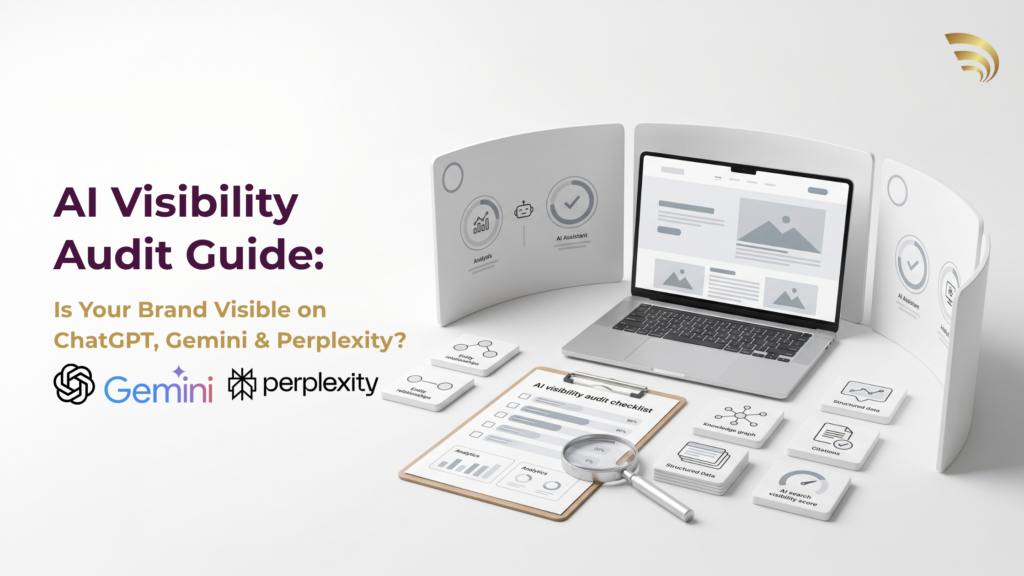
If your brand isn’t appearing in ChatGPT, Gemini, Perplexity, Claude, or Google’s AI Overviews, you’re already missing potential customers. An AI visibility audit helps you understand whether AI systems recognize, trust, and recommend your business and what you need to improve if they don’t.
Traditional SEO focuses on ranking web pages. AI search goes further. Large Language Models (LLMs) answer questions by synthesizing information from trusted sources rather than simply displaying a list of links. That means your website, brand mentions, structured data, digital authority, and reputation all influence whether AI assistants reference your business.
As AI-powered search becomes a normal part of how people research products, compare services, and make buying decisions, businesses need to measure brand visibility in AI search, not just Google rankings. This guide explains how to perform a complete AI visibility audit, what to measure, common issues that reduce LLM visibility, and practical ways to improve your presence across ChatGPT, Gemini, Perplexity, Claude, and emerging AI search platforms.
Key Takeaways
- AI visibility goes beyond SEO. It’s about whether AI systems recognise and trust your brand.
- Entity consistency matters. Keep your business information accurate and consistent across all platforms.
- Authority is earned. Expert content and trusted third-party mentions are stronger signals than keyword repetition.
- Schema supports understanding. Implement structured data to help search engines interpret your content.
- Audit regularly. AI models and search experiences change quickly, so review your visibility over time rather than treating it as a one-off exercise.
Table of Contents
What Is an AI Visibility Audit?
An AI visibility audit is the process of evaluating how often, how accurately, and in what context AI search engines mention your business.
Unlike a traditional SEO audit, which primarily measures rankings, crawlability, and backlinks, an AI visibility audit focuses on whether Large Language Models can confidently identify your brand as a trustworthy answer.
Think of it this way:
SEO asks: “Can Google find my page?”
AI Visibility asks: “Would ChatGPT confidently recommend my business when someone asks a relevant question?”
That’s a very different challenge. Modern AI systems evaluate information from multiple signals, including:
- High-quality websites
- Trusted publications
- Structured data
- Entity recognition
- Consistent business information
- Brand authority
- Expert content
- Citations across the web
If those signals are weak or inconsistent, your business becomes almost invisible to AI-generated answers even if you rank well in Google Search.
Why Does AI Search Visibility Matter?
AI search is changing how people discover businesses. Instead of clicking through ten blue links, users increasingly ask direct questions such as:
- “What’s the best CRM for small businesses?”
- “Which cybersecurity company is trusted by healthcare providers?”
- “Recommend an SEO agency for AI search optimisation.”
- “Best accounting software for freelancers.”
Rather than displaying hundreds of pages, AI assistants generate a curated answer. If your business isn’t included in those answers, you lose visibility before a visitor even reaches Google Search.
AI assistants influence earlier buying decisions
People now use AI to research products, compare services, understand pricing, evaluate competitors, find local businesses, learn industry terminology, and shortlist vendors.
That means AI search visibility now affects awareness, consideration, and purchase decisions.
AI visibility is becoming another trust signal
Search engines increasingly combine traditional search with AI-generated summaries.
Google’s AI Overviews, Microsoft’s Copilot, ChatGPT with browsing, Gemini and Perplexity all prioritise information from reliable sources rather than isolated webpages.
Businesses with recognised expertise, consistent digital entities, authoritative mentions, and well-structured websites are generally easier for AI systems to understand and reference.
AI Search vs Traditional SEO
Although they work together, they’re not the same.
| Traditional SEO | AI Search Visibility |
| Optimises pages | Optimises entities and knowledge |
| Measures rankings | Measures recommendations |
| Focuses on keywords | Focuses on topics and context |
| Search engines return links | AI generates direct answers |
| Rankings drive clicks | Citations build trust |
| Backlinks are critical | Brand authority and citations matter more |
Good SEO remains essential. But good SEO alone doesn’t guarantee strong ChatGPT visibility or LLM visibility.
How Do AI Models Decide Which Brands to Mention?
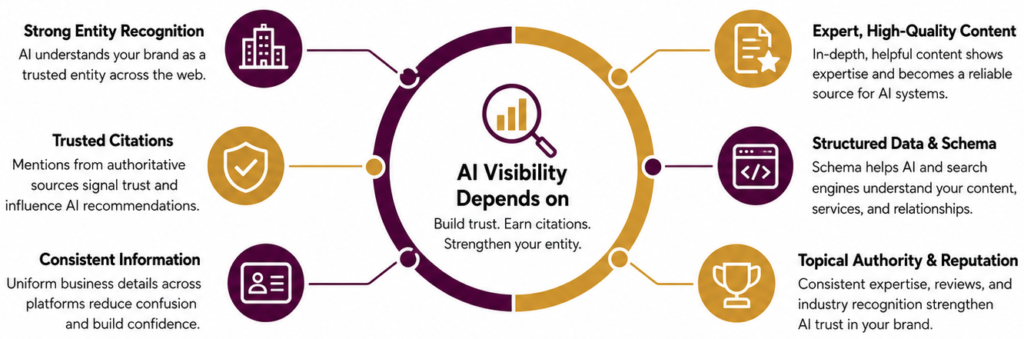
AI systems don’t simply copy Google’s rankings. Instead, they build confidence from multiple information sources.
Although every model works differently, several common signals consistently influence AI-generated recommendations.
1. Strong Entity Recognition
AI understands businesses as entities rather than collections of keywords.
For example:
Instead of recognising only: “Croccle AI SEO”
an AI model learns that:
- Croccle
- AI visibility
- GEO optimisation
- SEO consultancy
- AI search optimisation
are related concepts connected to one business. The clearer these relationships are across the web, the stronger your entity becomes.
2. Trusted Citations
AI values information that appears repeatedly across reliable sources.
Examples include:
- Industry publications
- Government websites
- University resources
- Recognised directories
- Well-established media
- Research reports
- Official documentation
One mention rarely changes anything. Consistent, trustworthy citations do. This is why an AI citation audit has become an important part of modern digital marketing.
3. Consistent Brand Information
Conflicting information creates uncertainty.
For example:
- Website says: Croccle Digital
- LinkedIn says: Croccle Technologies
- Crunchbase says: Croccle Solutions
AI now has to decide whether these refer to one company or three. Consistency strengthens confidence.
4. Expert Content
AI systems increasingly identify pages that genuinely answer questions.
Useful content often includes first-hand expertise, original examples, practical frameworks, detailed explanations, updated information, and clear authorship. Thin content rarely becomes a trusted reference.
5. Structured Data
Schema helps search engines and AI systems understand your content more accurately. While schema alone won’t make ChatGPT recommend your business, it provides valuable context about:
- organisation
- products
- services
- authors
- FAQs
- articles
- reviews
- locations
We’ll discuss schema in greater detail later in this guide.
Signs Your Brand Has Poor AI Search Visibility
Many businesses assume they have strong AI visibility because they rank well on Google. That’s often not the case. Here are common warning signs.
AI rarely mentions your company
Ask several AI assistants:
- “Who are the leading companies in…”
- “Recommend providers for…”
- “Who specialises in…”
If competitors appear repeatedly while your business never does, you likely have low brand visibility in AI search.
AI provides incorrect information
Examples include outdated company names, incorrect services, wrong headquarters, inaccurate descriptions, obsolete pricing, and discontinued products. Incorrect information usually indicates weak entity signals or outdated citations.
Competitors dominate AI responses
Sometimes AI consistently references competitors, media reviews, and industry analysts instead of your website.
This often means competitors have stronger digital authority.
Your content isn’t referenced
If your guides never appear in Perplexity citations or AI-generated answers, your content may lack depth, authority, topical relevance, and external validation.
Brand mentions are inconsistent
Businesses often discover dozens of inconsistent mentions across directories, press releases, social profiles, review platforms, and partner websites. These inconsistencies weaken AI confidence.
How to Perform an AI Visibility Audit
A good audit combines manual research with SEO tools, entity analysis, and AI testing. Think of it as measuring your digital reputation from an AI’s perspective.
Step 1: Check How AI Describes Your Brand
Start with manual testing. Ask ChatGPT, Gemini, Claude, and Perplexity questions like:
- What does Croccle do?
- Is Croccle an SEO company?
- Who are Croccle’s competitors?
- Recommend companies specialising in AI SEO.
- What services does Croccle provide?
Record:
- whether your business appears
- description accuracy
- competitors mentioned
- confidence level
- citations used
- missing information
Repeat this every few months.
Step 2: Measure AI Brand Mentions
Next, analyse where your company is mentioned online. Look for mentions across:
- news websites
- blogs
- podcasts
- interviews
- business directories
- research reports
- industry publications
- partner websites
Quality matters far more than quantity. One mention from an authoritative industry publication often carries more weight than dozens of low-quality directory listings.
Step 3: Review Entity Consistency
Your business information should match across every major platform.
Check:
| Platform | Information to Verify |
| Website | Company name |
| Google Business Profile | Address |
| Description | |
| Crunchbase | Industry |
| Social profiles | Branding |
| Directories | Phone number |
| Press releases | Business summary |
Any inconsistencies should be corrected.
Step 4: Audit Your Website Content
Ask yourself:
- Does every service have a dedicated page?
- Does the content answer real customer questions?
- Is the information current?
- Are authors identified?
- Are expert credentials visible?
- Are sources referenced?
- Are statistics up to date?
High-quality content gives AI systems reliable material to reference.
Step 5: Evaluate Structured Data
Structured data doesn’t guarantee AI citations, but it helps search engines understand your content. Review whether your website correctly implements:
- Organisation Schema
- Article Schema
- FAQ Schema
- Person Schema
- Product Schema
- Service Schema
- Breadcrumb Schema
- Local Business Schema (where relevant)
Use Google’s Rich Results Test and Schema Markup Validator to identify errors and missing properties before publishing.
Step 6: Analyse Brand Authority
Authority goes beyond backlinks. Review whether your business has expert authors, original research, customer success stories, industry recognition, conference speaking engagements, podcast appearances, trusted media mentions, and thought leadership content.
These signals strengthen your overall LLM visibility because they provide corroborating evidence that your brand is recognised beyond its own website.
Step 7: Compare Against Competitors
An AI visibility audit isn’t complete until you benchmark against competitors. Create a comparison table like this:
| Audit Area | Your Brand | Competitor A | Competitor B |
| Mentioned in ChatGPT | ✔ / ✖ | ✔ | ✔ |
| Mentioned in Perplexity | ✔ / ✖ | ✔ | ✔ |
| Knowledge Panel | ✔ / ✖ | ✔ | ✖ |
| High-authority media mentions | Low / Medium / High | High | Medium |
| Structured data coverage | Partial / Full | Full | Partial |
| Expert-authored content | Yes / No | Yes | Yes |
| Industry citations | Few / Moderate / Many | Many | Moderate |
This comparison quickly highlights where competitors have stronger digital authority and where your optimisation efforts should focus first.
What Should an AI Visibility Audit Deliver?
By the end of the audit, you should have clear answers to questions such as:
- Is my brand recognised by leading AI assistants?
- How accurate are AI-generated descriptions of my business?
- Where are the gaps in my online authority?
- Which competitors appear more often, and why?
- Are my brand details consistent across the web?
- Does my website provide enough structured, trustworthy information for AI systems to reference?
These findings become the foundation of an action plan to improve ChatGPT visibility, strengthen brand visibility in AI search, and increase the likelihood of being cited across AI-powered search experiences.
How to Increase AI Visibility of Your Website
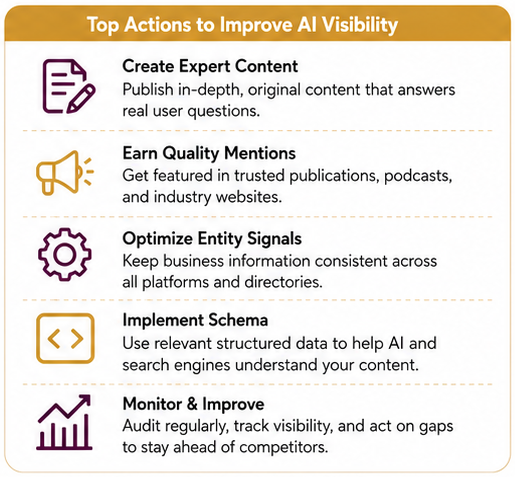
Improving AI search visibility isn’t about chasing a single ranking factor. It’s about making your brand easier for AI systems to understand, trust, and reference.
Focus on building a strong digital footprint instead of trying to “optimise for ChatGPT.” AI models rely on a combination of high-quality content, authoritative mentions, structured information, and entity recognition. Here are the areas that have the biggest impact.
1. Build Topic Authority, Not Just Individual Pages
Publishing one article about a topic rarely establishes expertise. Instead, create a content hub that answers related questions from different angles.
For example, if your business specialises in AI search optimisation, your content could cover:
- AI Visibility Audit
- GEO vs SEO
- How AI Search Works
- AI Overviews
- Entity SEO
- Schema for AI Search
- AI Citation Building
- Brand Mentions in LLMs
This helps search engines and AI systems associate your brand with an entire subject area rather than a single keyword.
2. Write Content That Answers Complete Questions
Large Language Models work best with content that provides complete, well-structured answers. Instead of writing vague introductions, start each section with a direct response.
For example:
Question: How do I increase visibility in ChatGPT?
Better answer: Improve your website’s authority, publish expert-led content, earn credible brand mentions, implement structured data, and maintain consistent business information across trusted platforms. These signals help AI systems recognise your brand as a reliable source.
This format increases the likelihood of your content being quoted in AI-generated responses.
3. Strengthen Your Brand Entity
Search engines increasingly rely on entities rather than keywords. Your business should have consistent information across:
- Website
- Google Business Profile
- Crunchbase
- Industry directories
- Social profiles
- Press releases
- Partner websites
Use the same:
- Company name
- Logo
- Website URL
- Description
- Contact information
Consistency helps AI connect these references to a single organisation.
4. Earn High-Quality Brand Mentions
AI systems are more likely to recognise businesses that are discussed beyond their own websites. Look for opportunities such as:
- Guest articles on respected industry publications
- Expert quotes in news stories
- Podcast interviews
- Conference presentations
- Research collaborations
- Original studies and surveys
- Professional association listings
These AI brand mentions reinforce your expertise and provide external validation.
5. Keep Content Fresh
AI search rewards accuracy. Review important pages regularly to:
- update statistics
- remove outdated information
- improve examples
- add recent developments
- answer new user questions
Freshness matters most for industries where information changes frequently.
Which Schema Types Help LLM Visibility?
Schema markup doesn’t directly influence whether ChatGPT recommends your business, but it helps search engines understand the relationships between your content, organisation, products, and people.
That understanding strengthens your overall digital entity. The following schema types are particularly useful.
| Schema Type | Purpose |
| Organisation | Defines your business identity |
| Person | Connects authors and subject matter experts |
| Article | Identifies editorial content |
| FAQ | Marks up question-and-answer content |
| Service | Describes professional services |
| Product | Defines products and offerings |
| LocalBusiness | Supports local search visibility |
| Breadcrumb | Explains page hierarchy |
| WebSite | Helps search engines understand site structure |
| Review | Provides structured customer feedback where appropriate |
Implement schema according to Schema.org guidelines and validate it using Google’s Rich Results Test.
Remember, schema supports understanding. It doesn’t replace quality content or authority.
What Tools Should You Use to Audit AI Search Visibility?
No single platform measures every aspect of AI visibility. A comprehensive audit combines several tools, each serving a different purpose.
AI Testing Platforms
Use:
- ChatGPT
- Gemini
- Claude
- Perplexity
Ask consistent questions and compare:
- Brand mentions
- Accuracy
- Competitor recommendations
- Source citations
- Missing information
Google Search Console
Google Search Console remains essential because it shows:
- indexed pages
- search performance
- crawl issues
- structured data problems
- Core Web Vitals
Strong technical SEO supports AI discoverability.
Google Rich Results Test
Use it to verify:
- Schema implementation
- Markup errors
- Supported structured data
Schema Markup Validator
Useful for checking whether your structured data follows Schema.org standards.
Brand Monitoring Platforms
Monitor mentions across the web using tools such as:
- Google Alerts
- Brand24
- Mention
- Meltwater
The goal is to understand where your business is being discussed and whether those mentions are accurate.
SEO Platforms
Tools such as:
- Ahrefs
- Semrush
- Moz
can help identify:
- Backlinks
- Referring domains
- Topical authority
- Competitor content
- Keyword coverage
While these tools weren’t built specifically for AI search, they provide many of the signals that influence AI recommendations.
Common Mistakes That Reduce AI Search Visibility
Many businesses unknowingly make it harder for AI systems to understand their brand. Avoid these common issues.
Publishing Thin Content
Short, generic pages rarely provide enough information for AI systems to reference confidently. Aim for depth, clarity, and originality.
Ignoring Entity Consistency
Different company names, addresses, or descriptions across platforms create confusion. Consistency builds trust.
Overusing Keywords
AI understands concepts, not just repeated phrases. Write naturally. Focus on answering questions rather than forcing keywords into every paragraph.
Missing Author Information
Content without clear authorship often appears less trustworthy. Include author names, credentials, experience, profile pages, where appropriate.
Neglecting External Authority
Publishing excellent content isn’t enough if nobody else references it. Earn citations from credible sources within your industry.
Forgetting Existing Content
Many organisations focus only on creating new articles. Regularly improve high-value pages by expanding explanations, correcting outdated facts, adding examples, and answering related questions.
Updating useful content often delivers better results than publishing dozens of new pages.
AI Visibility Audit Checklist
Use this checklist as a quick reference during your next audit.
| Audit Area | Complete |
| Brand appears in ChatGPT responses | ☐ |
| Brand appears in Gemini responses | ☐ |
| Brand appears in Perplexity responses | ☐ |
| AI descriptions are accurate | ☐ |
| Business information is consistent | ☐ |
| Organisation schema implemented | ☐ |
| Expert authors identified | ☐ |
| Content answers real customer questions | ☐ |
| High-quality external mentions earned | ☐ |
| Structured data validated | ☐ |
| Competitor comparison completed | ☐ |
| Content updated regularly | ☐ |
Treat this as an ongoing process rather than a one-time project. AI search continues to evolve, and your visibility should be reviewed periodically.
Frequently Asked Questions
How do I check AI visibility?
Search for your brand using AI assistants such as ChatGPT, Gemini, Claude, and Perplexity. Compare how each platform describes your company, whether it recommends your services, and which sources it cites.
How do I increase AI visibility of my website?
Improve content quality, publish expert-led resources, strengthen your brand entity, implement relevant schema, earn authoritative mentions, and maintain consistent business information across trusted platforms.
How do I increase visibility in ChatGPT?
You can’t directly submit your website to ChatGPT for ranking. Instead, focus on publishing accurate, authoritative content, earning trusted citations, and building a strong online presence.
How do I make my brand show up in ChatGPT?
Increase your digital authority by creating helpful content, earning mentions from respected publications, using structured data, and maintaining consistent information across your website and business profiles.
How do I increase business visibility on ChatGPT?
Treat ChatGPT visibility as an extension of your overall digital reputation. Build topical authority, strengthen your entity, improve technical SEO, gain credible backlinks, and encourage trustworthy third-party mentions rather than focusing on one platform alone.
What tools should we use to audit our AI search visibility?
Use a combination of ChatGPT, Gemini, Claude, Perplexity, Google Search Console, Google Rich Results Test, Schema Markup Validator, Google Alerts, and SEO platforms such as Ahrefs or Semrush.
What is brand visibility?
Brand visibility refers to how easily people can discover and recognise your business across search engines, AI assistants, social platforms, media coverage, and other digital channels.
How will you improve your brand’s visibility?
Start by understanding your audience’s questions. Then create expert content that answers those questions, optimise your website technically, build authority through trusted mentions, and maintain consistent branding across every platform.
What is the difference between brand awareness and visibility?
Brand awareness measures whether people recognise or remember your business. Brand visibility measures how often your business appears when people search, browse, or ask AI assistants for recommendations. Awareness is about recognition; visibility is about discoverability.
What schema types are used for LLM visibility?
Useful schema types include Organisation, Person, Article, FAQ, Service, Product, LocalBusiness, Breadcrumb, and WebSite.
Conclusion
AI-powered search is changing how people discover brands, compare providers, and make decisions. Being visible in ChatGPT, Gemini, Perplexity, and other AI assistants isn’t the result of a single optimisation tactic. It comes from building a trustworthy digital presence that AI systems can understand and verify.
An effective AI visibility audit helps you identify gaps before they affect your business. It shows whether your brand is recognised, whether AI-generated information is accurate, and where competitors have stronger authority. More importantly, it gives you a practical roadmap for improving brand visibility in AI search, increasing LLM visibility, and strengthening your presence across both traditional search engines and AI-driven experiences.
As search continues to evolve, businesses that invest in clear expertise, consistent entities, authoritative content, and credible brand mentions will be better positioned to earn recommendations, whether the answer comes from a search engine or an AI assistant.
Croccle helps brands stay discoverable in an AI-first search environment. We combine technical SEO, AI search optimization, structured content, entity-based SEO, schema implementation, and digital authority building to strengthen your visibility across ChatGPT, Gemini, Perplexity, Claude, and Google’s AI-powered search experiences. Our approach is designed to improve long-term brand recognition, trusted AI citations, and sustainable organic growth, not just rankings. Contact us now for digital marketing services in India.
About the Author
Dev Gupta (DG) is the Founder of Croccle, a digital growth consultancy helping businesses build a stronger online presence through branding, SEO, AI search optimisation, content strategy, social media, and performance marketing. With years of experience and a track record of working with 100+ brands across diverse industries, he shares practical insights to help businesses stay ahead in an evolving digital world.
Connect and follow him on LinkedIn