
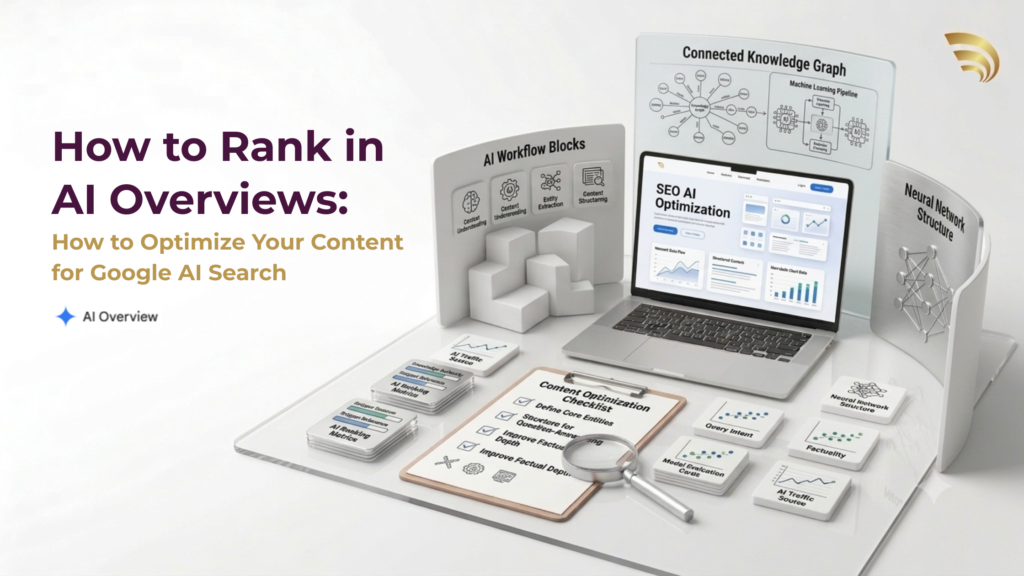
Google Search has changed considerably since AI Overviews first appeared. Searchers can now get an AI-generated summary, follow links to supporting pages, ask follow-up questions, and continue into AI Mode for more detailed research. As of August 2026, Google says AI Overviews have more than 2.5 billion monthly active users, while AI Mode has passed one billion monthly users.
So, how do you rank in AI Overviews?
There isn’t a separate AI Overview trick or a special piece of markup that guarantees inclusion. Google says the same core SEO principles still apply: your page needs to be crawlable, indexable, useful, reliable, relevant to the query, and genuinely valuable to people. What changes is the way Google’s systems can discover and combine information. AI Overviews and AI Mode may use query fan-out, where one question leads to several related searches before an answer is assembled.
That makes AI search optimization less about writing for a machine and more about making your content a strong source for the questions people actually ask.
Table of Contents
What Are Google AI Overviews?
Google AI Overviews are AI-generated responses that appear within Search for queries where Google’s systems determine that an AI response can add value. The response can summarize information from multiple sources and provide links that let users investigate the subject further. AI Mode takes the experience further by handling longer, more complex questions and follow-up research.
For publishers, the important distinction is this: you aren’t trying to rank an AI Overview itself. You’re trying to make your page eligible to be selected as a supporting source within Google’s AI search experience.
Google says a page must be indexed and eligible to appear with a normal search snippet to be considered for AI Overviews or AI Mode. There are no additional technical requirements specifically for these features.
How Do You Rank in AI Overviews?
To maximize AI Overview visibility, combine core technical SEO with direct, intent-matched answers. That means understanding the main question, covering the related questions a person is likely to ask next, demonstrating real expertise, supporting important claims, and keeping the page technically accessible to Google.
This matters because AI search doesn’t always work from one exact keyword. Google’s systems can explore related queries and sources before generating a response. Google calls this query fan-out.
Third-party research points in the same direction. SE Ranking reported that 92.36% of the AI Overviews it studied included at least one domain ranking in the organic top 10, while 63.19% pulled information from a top-10 organic page. That doesn’t mean a top-10 ranking guarantees an AI Overview citation, but it reinforces a simple point: don’t abandon conventional SEO while optimizing for AI search.
10 Ways to Optimize Content for AI Overviews
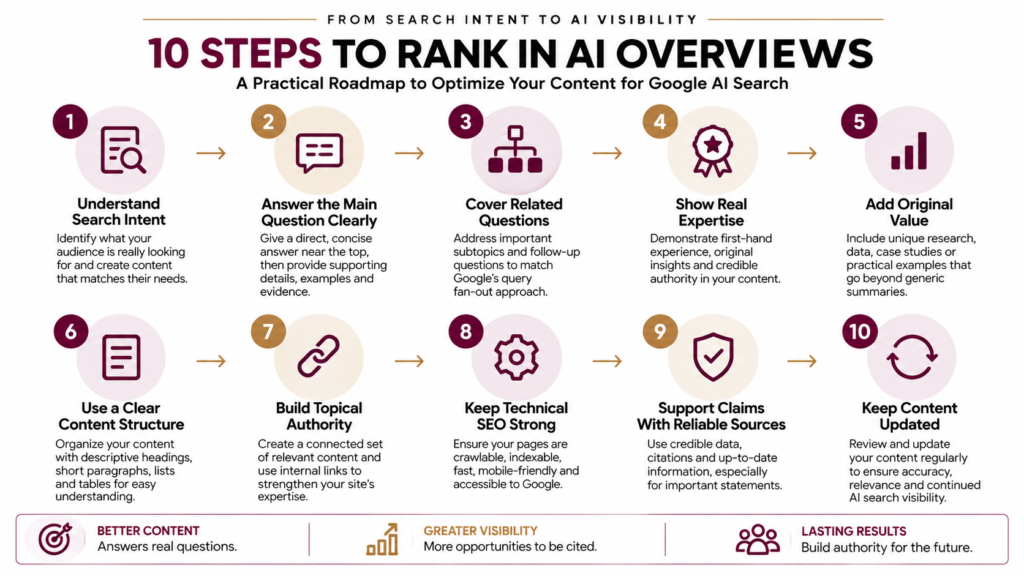
1. Answer the Main Question Early
Don’t make readers work through three paragraphs of background before they reach the answer.
If the page targets “how to rank in AI Overviews,” answer that question near the beginning. You can then explain the reasoning, evidence, examples, and practical steps underneath it.
A useful structure is:
Question → direct answer → explanation → evidence → example
This also makes individual sections easier for search systems to understand without turning the article into a collection of disconnected one-line answers.
2. Build the Page Around Search Intent
A keyword tells you what someone typed. Search intent tells you what they actually want.
Someone searching “AI Overview SEO” may want a definition. Someone searching “how to optimize for AI Overviews” wants a process. Someone searching “does schema help AI Overviews?” wants a specific answer.
Your content should reflect those differences. Before expanding an article, ask:
- What does the searcher want to know?
- What would they ask next?
- What information would help them make a decision?
- What would make them trust the answer?
- What important part of the question is missing from competing pages?
That is much more useful than adding the target keyword another 15 times.
3. Cover Related Questions Without Losing Focus
AI search can explore several related queries when responding to one question. Your content should therefore cover the important supporting topics, but it shouldn’t become a dumping ground for every keyword you can find.
For example, a page about how to rank in AI Overviews can naturally discuss:
- AI Overview ranking
- AI search optimization
- query fan-out
- content structure
- topical authority
- technical SEO
- original research
- citations and sources
- internal linking
- AI visibility measurement
This creates stronger topical coverage while keeping one clear purpose for the page.
SE Ranking’s research also found that longer queries were particularly common among searches triggering AI Overviews, with queries of four or more words triggering them in 60.85% of its dataset.
4. Give AI Search Something Worth Citing
Commodity content gives AI engines zero reason to cite you. Differentiate with original research, proprietary data, and first-hand experience. Original value can come from:
- First-hand experience
- Original research
- Proprietary data
- Expert commentary
- Unique comparisons
- Practical examples
- Tested processes
- Clear frameworks
- Industry-specific observations
- Updated information that corrects older advice
Google’s current guidance specifically tells publishers to create unique, non-commodity content rather than trying to find special “GEO hacks.”
This is one of the biggest shifts in AI search optimization. If your article simply summarizes what everyone else has already said, there may be little reason for an AI system to select it.
5. Make Expertise Visible
Expertise shouldn’t be limited to an author bio at the bottom of the page. Show it through the actual content.
If you’re writing about technical SEO, explain the technical trade-offs. If you’re writing about healthcare marketing, discuss the regulatory considerations. If you’re writing about finance, distinguish between general education and advice that depends on an individual’s circumstances.
Use sources when a claim needs support. Give dates when information changes quickly. Explain how you reached a conclusion when you’re presenting an original recommendation.
Google’s guidance for generative AI search continues to emphasize helpful, reliable, people-first content and established Search quality principles.
6. Structure Content So People Can Find the Answer
Good structure helps readers first.
Use descriptive H2s and H3s, tables where a comparison genuinely helps, numbered steps for processes, and paragraphs that don’t bury the main point.
For example:
H2: Does Schema Markup Help AI Overviews?
Start with the answer.
Then explain what structured data actually does, where it is useful, and what it cannot do.
Google says structured data can help it understand page content, but there is no special schema type required for AI Overviews or AI Mode. The markup should accurately represent visible content on the page.
That distinction matters. Adding unnecessary schema because someone called it an “AI ranking hack” isn’t a sound SEO strategy.
7. Build Topical Authority Across Your Site
One strong article can rank. A connected group of useful articles can demonstrate that your site actually covers a subject well.
Suppose your main page targets AI search optimization. Supporting pages might cover:
- AI Overview SEO
- Google AI Mode
- Generative Engine Optimization
- LLM SEO
- AI citations
- Answer Engine Optimization
- AI search analytics
- Content optimization for AI search
Link these pages where the connection is genuinely useful.
The goal isn’t to manufacture hundreds of pages. It is to make the site’s expertise easier to understand and easier for visitors to explore.
8. Keep Technical SEO in Good Shape
AI search doesn’t remove the technical requirements of Search.
Google says pages need to be indexed and eligible to appear in normal Search to be considered as supporting links in AI Overviews and AI Mode. It also recommends maintaining the basics: allow crawling, use sensible internal links, provide important content in text, maintain good page experience, and ensure structured data matches visible content.
Check the basics before looking for advanced AI SEO tactics:
- Can Google crawl the page?
- Is the page indexed?
- Is important information available in text?
- Are internal links helping discovery?
- Are there accidental noindex or snippet restrictions?
- Does the page work well on mobile?
- Are important resources blocked by technical issues?
A technically inaccessible page cannot become a useful AI citation.
9. Don’t Chase AI-Specific “Hacks”
This is where a lot of AI SEO advice has gone off track.
You may have seen recommendations involving llms.txt, excessive content “chunking,” artificial mentions, or other techniques presented as requirements for AI visibility.
Google’s latest guidance is much clearer: you don’t need to create AI-specific text files or use special markup to appear in its generative AI features. Google also says llms.txt has no positive or negative effect on Google Search visibility or rankings.
That doesn’t mean every emerging technique is useless for every AI system. It means you shouldn’t confuse a third-party experiment with a Google ranking requirement.
Spend your time first on content quality, technical SEO, useful internal linking, evidence, expertise, and original information.
10. Keep Important Content Current
An article about AI Search can become outdated unusually quickly because the product itself keeps changing.
For example, Google has introduced new AI Overview and AI Mode capabilities, expanded access, added Preferred Sources to AI experiences, and launched dedicated generative AI visibility reporting in Search Console during 2026.
When updating an AI search article, don’t simply change the publication date.
Check:
- Whether Google’s terminology has changed
- Whether a feature still exists
- Whether a recommendation is still supported
- Whether statistics are still current
- Whether screenshots reflect the current interface
- Whether third-party research has been superseded
- Whether your examples still make sense
A genuine update improves the page. Changing a date without changing the information doesn’t.
How Query Fan-Out Changes AI Search Optimization
Query fan-out is one of the most useful concepts to understand when planning content for Google AI Search.
Imagine someone asks:
“How can I improve my website’s visibility in AI search?”
The system may need information about several related subjects before producing a useful response:
Main question
↓
AI search optimization
↓
Technical SEO
Content quality
Search intent
Topical authority
Original information
Related queries
Trust signals
Relevant sources
Google says AI Overviews and AI Mode may issue multiple related searches across subtopics and data sources before developing a response.
This gives content teams a practical lesson: don’t optimize a page around one phrase in isolation. Build it so the page can answer the important questions surrounding that phrase.
How to Get Your Content Cited in AI Search
Getting cited by AI isn’t the same as winning a traditional blue-link ranking.
A useful AI citation often comes from a passage that clearly supports a particular statement or part of an answer. That means individual sections should be understandable on their own.
For example, don’t write five vague paragraphs about “the importance of AI SEO” and expect an AI system to figure out your point.
Instead:
Does traditional SEO still matter for AI Overviews?
Yes. Traditional SEO remains important because Google’s AI search features use core Search ranking and quality systems to find relevant web content.
Then explain the evidence.
That gives the system a clear statement while giving the reader enough context to understand it.
Google says its generative AI features use techniques including retrieval-augmented generation and query fan-out to retrieve relevant pages and build responses, with prominent links to supporting web pages.
SEO vs AEO vs GEO vs LLM SEO
These terms overlap, but they’re often presented as if they’re completely separate disciplines.
| Approach | Main focus |
| SEO | Visibility in search engines |
| AEO | Clear answers to search questions |
| GEO | Visibility in generative search experiences |
| LLM SEO | Visibility, mentions, and citations in LLM-based systems |
| AI Search Optimization | Visibility across AI-powered search experiences |
For Google Search, don’t treat GEO as a replacement for SEO.
Google itself says that what some practitioners call AEO or GEO is still, from Google’s perspective, part of optimizing for the search experience. Its current guidance specifically recommends applying established SEO practices rather than chasing separate “AEO/GEO hacks.”
How to Measure AI Search Visibility
Measurement has become much easier in 2026.
Google rolled out Generative AI performance reports in Search Console worldwide by August 31, 2026. These reports provide dedicated views of visibility in generative AI features across Search and Discover, including impressions, pages, countries, devices, and dates.
That gives you a better starting point than guessing whether your content is appearing in AI results.
Track:
- Generative AI impressions
- Pages appearing in AI features
- Queries and topics associated with visibility
- Organic rankings for the same subjects
- Branded searches
- Referral traffic
- Leads or conversions
- Engagement after the visit
- Competitor visibility where your tracking platform supports it
Third-party tools can add useful monitoring and competitive analysis. For example, Semrush now reports AI Overview presence, citations, competitor visibility, and changes over time, while SE Ranking provides AI Overview research and tracking features.
Use these tools for analysis, not as a source of supposed secret Google ranking signals. Google explicitly warns that third-party tools do not have access to its internal ranking or AI systems.
Common AI Overview SEO Mistakes
Writing for AI instead of people
If the article is difficult for a person to understand, adding AI-related keywords won’t fix it.
Repeating the same keyword
“AI Overview,” “AI search,” and “GEO” don’t need to appear in every paragraph. Cover the concepts naturally.
Publishing generic summaries
If ten competing pages say the same thing, another summary adds little.
Ignoring traditional SEO
AI search doesn’t make crawling, indexing, relevance, internal links, quality, or page experience irrelevant.
Treating third-party experiments as Google rules
A tactic reported by an SEO tool or agency may be worth testing. It isn’t automatically a Google requirement.
Chasing citations instead of business value
A citation is useful, but the bigger question is what happens after someone discovers your brand. Measure qualified traffic, engagement, enquiries, leads, and conversions where appropriate.
Final Takeaway: How to Rank in AI Overviews
If you want to rank in AI Overviews, start with the same foundation that makes a good search result: a crawlable, indexable page that gives people a useful answer.
Then make the page worth citing.
Answer the main question early. Cover the important related questions. Use evidence where it matters. Show genuine expertise. Add original information instead of rewriting what everyone else has published. Connect the page to useful supporting content across your site, and keep the information current.
Most importantly, don’t build your strategy around the idea that AI search has replaced SEO. Google’s own guidance says the opposite: its AI search features are built on core Search systems, and strong SEO remains relevant.
The practical goal is simple: create content that is useful enough for a person to trust and clear enough for a search system to understand. That gives you a stronger foundation for Google Search, AI Overviews, AI Mode, AEO, and broader generative search visibility.
FAQs
How do I rank in Google AI Overviews?
There is no guaranteed formula for appearing in Google AI Overviews. Improve your chances by following Google’s core SEO requirements, creating useful and original content, matching search intent, maintaining strong technical SEO, demonstrating expertise, and answering important related questions clearly.
Does traditional SEO still matter for AI Overviews?
Yes. Google says traditional SEO best practices remain relevant because AI Overviews and AI Mode use core Search ranking and quality systems to find supporting web content.
How do I optimize content for AI search?
Start by understanding the searcher’s main question and related needs. Give a direct answer, explain the subject thoroughly, support important claims, demonstrate expertise, use clear structure, maintain technical SEO, and provide information that goes beyond generic summaries.
Does schema markup help AI Overviews?
There is no special schema markup required for AI Overviews or AI Mode. Google recommends that structured data accurately describe the visible content on the page, but adding schema specifically as an AI Overview ranking hack isn’t supported by Google’s guidance.
Does llms.txt help Google AI Overviews?
Google says llms.txt is not needed for Google Search and has no positive or negative effect on Google Search visibility or rankings. It may still be used for other services that support the format, but it shouldn’t be treated as a Google AI Overview requirement.
How can I get my content cited by AI?
Create content that directly supports specific questions and claims. Clear answers, original research, useful examples, credible sources, strong topical coverage, and accessible technical implementation can make a page more useful as a supporting source. There is no guaranteed citation formula.
What is the difference between SEO and GEO?
SEO covers optimization for search visibility broadly. GEO, or Generative Engine Optimization, is commonly used to describe efforts to improve visibility in generative AI experiences. For Google, these aren’t separate replacement systems; Google recommends continuing to apply strong SEO practices to its generative AI search features.
How can I measure AI search visibility?
Google’s Generative AI performance reports in Search Console provide dedicated visibility data for generative AI features, including impressions, pages, countries, devices, and dates. Third-party platforms can provide additional citation and competitor analysis.
About the Author
Dev Gupta (DG) is the Founder of Croccle, a digital growth consultancy helping businesses build a stronger online presence through branding, SEO, AI search optimisation, content strategy, social media, and performance marketing. With years of experience and a track record of working with 100+ brands across diverse industries, he shares practical insights to help businesses stay ahead in an evolving digital world.
Connect and follow him on LinkedIn.