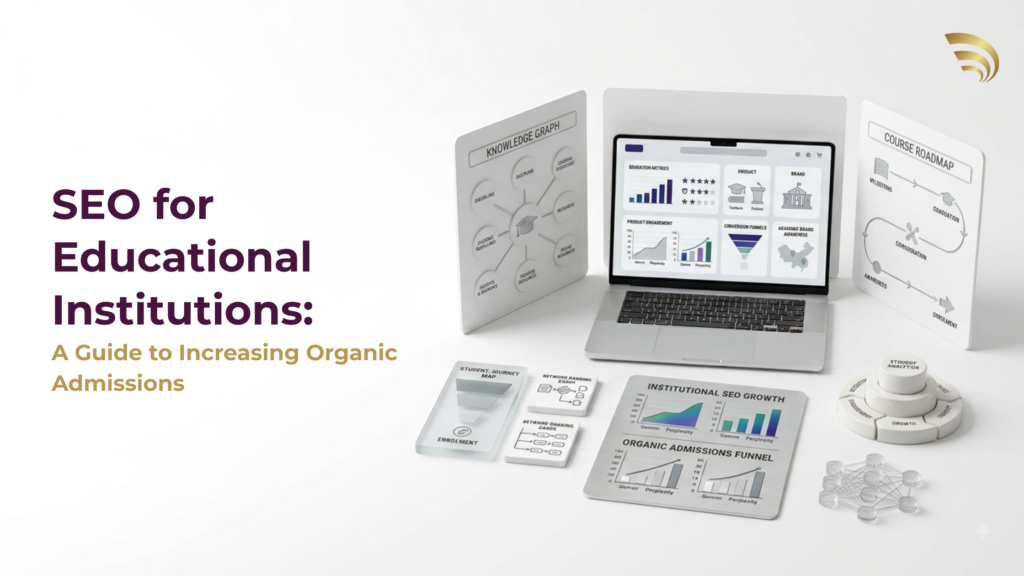
SEO for educational institutions helps your school, college, or university get found when a student or parent is actually looking for information. That could be a parent searching for a school nearby, a student comparing MBA colleges, or someone checking eligibility, fees, or admission dates. Good SEO connects those searches with useful pages on your website, so the traffic you attract has a real reason to enquire, apply, or learn more.
For an institution competing for admissions in India, organic search can become a long-term acquisition channel because students often research extensively before choosing a school, college, or university.
Key Takeaways
- SEO should support the admissions journey, not just increase rankings or website traffic.
- Schools, colleges, and universities need different SEO strategies based on their audience, location, programmes, and search behaviour.
- Programme, admissions, fees, eligibility, and location pages should be the foundation of an education SEO strategy, with supporting content built around them.
- Search intent should guide keyword and content planning rather than creating pages simply to target more keywords.
- Local SEO is especially important for schools and location-focused colleges, where parents and students often search by city, area, or campus.
- Technical SEO, internal linking, and clear site architecture help users and search engines discover important programme and admissions pages.
- Authoritative, original content can strengthen visibility and credibility, particularly when supported by research, faculty expertise, data, and trustworthy sources.
- SEO performance should be measured by qualified enquiries and applications, not rankings and traffic alone.
- SEO, paid search, and conversion tracking can work together to support both immediate and long-term student acquisition.
- The best education SEO strategy focuses on helping the right student find the right information at the right stage of the decision process.
Table of Contents
Why Is SEO Important for Educational Institutions?
If you’re a parent looking for a school, what do you usually do first? You search. The same thing happens with higher education: students search for courses, compare colleges, check fees, read about placements, and then shortlist a few options. That behaviour is exactly why SEO for higher education deserves a place in an institution’s admissions strategy.
The scale of the opportunity is significant. Industry research indicates that more than 33% of website traffic across education portals stems from organic search, reinforcing why search visibility can be valuable for institutions that depend on digital discovery.
But traffic alone isn’t the objective.
Consider a university ranking for “what is a bachelor’s degree” and another ranking for “MBA college in Mumbai admissions.” Both may generate visitors, but the second search has a much clearer connection to enrolment.
That’s why SEO for higher education should connect search demand with the actual admissions journey.
A useful framework is:
Search → Visit → Research → Compare → Enquire → Apply → Enrol
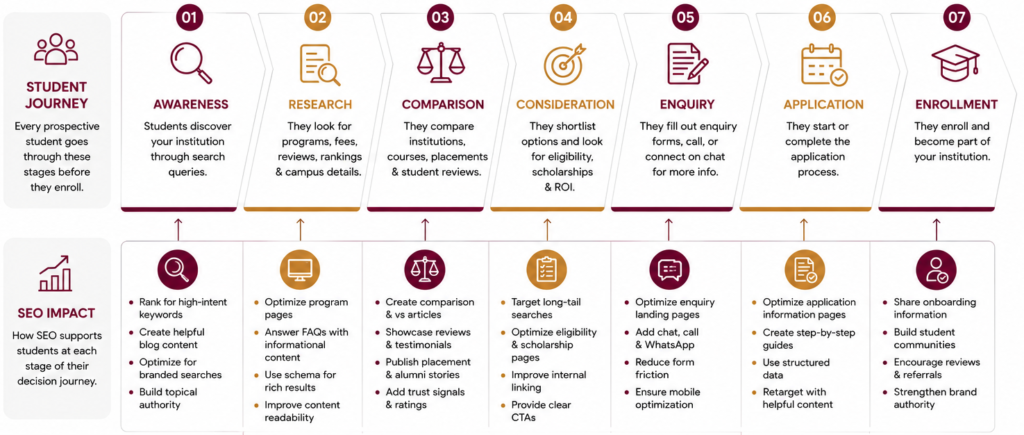
The SEO strategy should support every stage rather than focusing only on rankings.
What Makes SEO for Schools, Colleges and Universities Different?
An education website can get complicated very quickly. A university may have hundreds of programme pages, departments, faculty profiles, research pages, admission details and campus information.
A school has a different problem: most of its search demand may come from parents living within a relatively small area. SEO for colleges, SEO for universities and SEO for schools therefore need different priorities, even though the basic SEO principles remain the same.
A school may primarily target parents within a specific geographic area. A college may need to attract students from several states, while a university could target national or international applicants across dozens of programmes.
This creates different search patterns.
SEO for Schools
SEO for schools usually has a strong local component. Parents may search for:
- Best schools in [city]
- CBSE schools near me
- International schools in [city]
- Best school for children in [area]
- School admissions in [city]
- Nursery or kindergarten admissions
The website therefore needs strong location signals, useful admissions pages, and content that answers parent questions.
SEO for Colleges
For colleges, search intent often revolves around courses, eligibility, fees, placements, entrance examinations, and career options.
A college might target searches such as:
- BBA colleges in Mumbai
- MBA colleges in Maharashtra
- PGDM admission
- Best college for BCA
- MBA fees in India
- Courses after graduation
For colleges, SEO works best when students can find clear answers about the programme they are considering. A page that simply lists courses may not be enough if prospective students still need to search elsewhere for eligibility, fees, specialisations, placements, or admission dates.
For example, a management college in Mumbai should make it easy for prospective students to find information about its PGDM programmes, specialisations, fees, eligibility, and admission process. Supporting articles can answer related questions and link students back to the relevant programme pages.
The goal is not to create a separate page for every keyword variation. It is to make the right page useful enough to answer the student’s question.
SEO for Universities
SEO for universities requires a broader content architecture. A university may need optimised pages for individual programmes, departments, campuses, admissions, scholarships, research, faculty, and student life.
This is where seo strategy for higher education becomes particularly important. Thousands of pages cannot be treated as unrelated pieces of content. They need a logical structure.
How Should You Build an SEO Keyword Strategy for Higher Education?
The first mistake I’d avoid with an SEO keyword strategy for higher education is building a huge spreadsheet of keywords and then trying to squeeze all of them into existing pages. Start with the questions students actually ask. Then decide which page should answer each question. “MBA colleges in Mumbai,” “MBA fees,” and “MBA eligibility” may all relate to the same course, but they don’t necessarily belong on the same page.
Start by dividing keywords according to intent.
| Search intent | Example | Best page |
| Programme | MBA in Finance | Programme page |
| Location | Universities in Pune | Location/category page |
| Admission | MBA admission 2026 | Admissions page |
| Eligibility | MBA eligibility after graduation | Guide/blog |
| Fees | MBA fees in Mumbai | Programme/fees page |
| Career | Jobs after MBA in Finance | Blog/career guide |
| Comparison | MBA vs PGDM | Comparison guide |
| Brand | University name admission | Admissions page |
Focus on Long-Tail Searches
Long-tail or Broad keywords can bring plenty of searches, but they don’t always tell you what the person wants.
For example, “MBA” is broad.
“Best MBA colleges in Mumbai for working professionals” gives much more information about what the searcher wants.
The referenced Neil Patel article also recommends combining programme-specific terms, location keywords, admissions searches, scholarships, campus-life topics, and longer, more specific queries rather than relying on broad keywords alone.
Google’s current SEO guidance also recommends anticipating the different terms users might search for while avoiding repetitive keyword insertion. Google’s systems can understand related queries without requiring every variation to appear word-for-word on a page.
Accounting for Admissions Seasonality in Search Volume
Education searches follow rigid annual cycles aligned with academic calendars and entrance exam schedules (e.g., peak interest in India spans May through August for admissions, with secondary spikes around exam announcements in December–February).
Keyword strategies should account for these lead times: publish or refresh core programme, fee, and eligibility content 2 to 3 months before peak search demand so search engines can crawl, index, and establish rank authority before students begin active shortlisting.
What Content Should Educational Institutions Create for SEO?
Don’t make the blog section carry the entire education SEO strategy. Your most important pages are often the ones directly connected to the institution: programmes, admissions, fees, eligibility, campuses and departments. Blog content should then fill the gaps around those pages by answering the questions students ask before they’re ready to apply.
Useful content types include:
- Programme pages
- Admission guides
- Eligibility guides
- Fee explanations
- Scholarship information
- Faculty profiles
- Student success stories
- Alumni stories
- Career guides
- Campus guides
- Entrance-exam resources
- Course comparisons
- FAQs
- Research and academic content
Take an MBA programme as an example. One generic “MBA” page can’t realistically answer every question a prospective student has. Someone may want to know about eligibility, another person may be comparing fees, and someone else may be researching career options. Give each important search intent its own useful page and connect those pages properly.
MBA Programme → MBA Eligibility → MBA Fees → MBA Admission Process → MBA Specialisations → Jobs After MBA → MBA vs PGDM
Each page answers a different question and can link naturally to the others.
This approach also gives search engines clearer context about the institution’s subject expertise.
Google’s SEO guidance specifically recommends unique, useful, well-organised, and up-to-date content rather than simply reworking information already available elsewhere.
How Important Is Local SEO for Schools and Colleges?
For a school, location can make or break the search strategy. A family in Pune isn’t looking for “schools in India”; they’re looking for schools they can realistically visit every day. The same applies to colleges competing within Mumbai, Delhi, Bengaluru, or another education hub. That’s where local SEO becomes much more than adding a city name to a page.
For schools, location-based searches can include:
- Best school in [city]
- Schools near [locality]
- CBSE school in [city]
- International school near me
- School admission in [city]
When planning local SEO for college, look beyond broad searches such as “colleges in Mumbai.” Students may also search for a particular programme in a city, compare nearby institutions, or look for admission information before deciding where to apply.
Depending on the programmes offered, useful keyword themes could include:
- PGDM colleges in Mumbai
- MBA colleges in [city]
- BBA colleges near [locality]
- college admissions in [city]
- [programme name] colleges in [city]
- [specialisation] courses in [city]
Use these as research starting points, not as a checklist for creating dozens of similar pages. Review actual search demand and the pages already available on the website. A location page should offer genuine information about the campus, programmes, facilities, or admissions rather than just repeating a city name.
Also check that the college’s Google Business Profile contains accurate information and points visitors to the most relevant official page.
Optimise Google Business Profile
Institutions should maintain accurate information on their Google Business Profile, including address, phone number, website, and other relevant business details.
Google’s official guidance says businesses should provide accurate and complete information so customers can understand what the business offers and where it is located.
For institutions with multiple campuses, each location needs careful management rather than duplicate or misleading location pages.
Create Useful Location Content
Don’t create dozens of city pages that simply replace one city name with another.
A useful location page should actually tell prospective students something relevant about that campus, programme availability, location, facilities, or admissions process. That distinction matters for both users and search quality.
What Technical SEO Should Educational Institutions Prioritise?
Technical SEO is easy to ignore until something breaks. A programme page that isn’t indexed, a broken admissions link, a slow mobile page, or a confusing URL structure can quietly cost an institution search visibility and prospective-student enquiries. On a large university website, small technical problems can multiply across hundreds of pages, so regular technical checks are worth doing.
For large education websites, start with:
- Crawlability
- Indexation
- XML sitemap
- Canonical URLs
- Mobile usability
- Page speed
- Internal linking
- Broken-link management
- Redirects
- HTTPS
- Structured data where appropriate
- Clear URL structures
- Image optimisation
- Accessible navigation
Site architecture deserves particular attention because university and college websites can contain large numbers of programme, faculty and departmental pages.
A prospective student should be able to move logically from:
University → Department → Programme → Admission → Application
Google states that logical site organisation can help search engines and users understand how pages relate to one another. It also recommends descriptive URLs and relevant internal links.
How Can Internal Linking Improve Education SEO?
Think about what a student needs to know next. If someone is reading your MBA programme page, they may immediately want to check eligibility, fees, specialisations, or career options. Give them those links while they’re already on the page. It helps the student move through the website naturally, and it also gives Google a clearer picture of how your important pages relate to one another.
For example, an MBA programme page could link to:
- MBA eligibility
- MBA fees
- MBA admission process
- MBA specialisations
- MBA career opportunities
- Campus facilities
A blog about “Jobs After MBA in Finance” could then link back to the relevant MBA Finance programme page.
This creates a connected website rather than a collection of isolated articles.
Use descriptive anchor text where it makes sense. Google recommends relevant link text because it helps users and search engines understand the destination page.
How Does Authority Building Help Higher Education SEO?
Authority building gives educational websites stronger opportunities to earn visibility when other credible websites reference their content. For universities and colleges, useful sources of links can include academic organisations, government resources, research publications, industry partners, news coverage, events and alumni networks.
The easiest way to earn relevant links isn’t usually to ask hundreds of websites for them. Create something worth referencing.
Examples include:
- Original research
- Education reports
- Student surveys
- Faculty research
- Industry studies
- Scholarship resources
- Admission data
- Useful academic guides
For example, for one of our management college clients, local SEO and programme page optimization led to an 18% increase in organic enquiries year-over-year. The case study also reported a 75%+ increase in sessions for heavily affected campus and programme pages and a 411% year-over-year increase in organic sessions for newly targeted programme expansion efforts. These are case-specific results, not universal SEO benchmarks.
That distinction is important when evaluating any higher education SEO case study.
How Should You Measure SEO for Educational Institutions?
Rankings are useful, but I wouldn’t make them the final scorecard. A page moving from position 18 to position 8 is encouraging, but the admissions team ultimately wants to know whether the change brought better visitors, more enquiries, or more applications. Your reporting should connect what happens in Google Search with what happens after the visitor reaches the website.
Track a combination of:
- Organic clicks
- Organic impressions
- Search queries
- Ranking changes
- Non-brand traffic
- Local search visibility
- Programme-page traffic
- Admissions-page traffic
- Enquiries
- Application starts
- Organic applications
- Organic-assisted conversions
Google Search Console can help institutions understand how their pages perform in Google Search, while analytics data can help connect organic visits with actions on the website.
Google also recommends establishing a baseline and allowing time to evaluate SEO changes. Search impact can take weeks or months depending on the change and the site.
For admissions teams, one metric deserves special attention: How many qualified enquiries came from organic search?
That’s a much more useful question than simply asking how many keywords moved into the top 10.
SEO vs Search Engine Marketing for Higher Education
SEO and search engine marketing serve different roles. SEO builds organic visibility over time, while paid search can place an institution in front of relevant searches immediately when campaigns are active.
For example, a university preparing for admissions may use paid search to capture immediate demand while its SEO programme builds stronger organic visibility around the same courses.
This makes search engine marketing for higher education useful as part of a broader acquisition strategy. The two can also inform each other. Paid search data can reveal valuable search terms and messaging, while strong organic pages can support users who need more information before applying.
When Should You Hire Higher Education SEO Services?
Higher education SEO services can make sense when an institution has a large website, multiple programmes, several campuses, or an internal team that doesn’t have the time or technical expertise to manage search performance.
Before hiring an seo agency for education or seo company for education, ask how they approach:
- Technical SEO
- Keyword research
- Programme-page optimisation
- Local SEO
- Content strategy
- Internal linking
- Search Console
- Conversion tracking
- Reporting
- Content updates
Be cautious of agencies promising a guaranteed number-one ranking. Google itself states that there are no secrets that automatically place a website first in Search.
If you’re comparing Top SEO services for schools & educational institutes in India or searching for Top SEO services for schools & educational institutes near me, compare agencies on their process and evidence of relevant work rather than promises alone.
Must Read: Google Ads vs Meta Ads for Education Admissions
FAQs About SEO for Educational Institutions in India
How does SEO help educational institutions increase admissions?
SEO helps institutions appear when prospective students and parents search for programmes, schools, courses, admissions, fees, eligibility, and related questions. When those searches lead to useful pages and clear enquiry paths, organic traffic can contribute to qualified admissions enquiries and applications.
What is the best SEO strategy for universities?
A strong strategy combines programme-level keyword research, useful content, technical SEO, internal linking, local SEO where relevant, authority building and conversion tracking. Universities should also structure their large websites so programme, department, faculty, and admissions pages are easy to discover.
Is local SEO important for schools?
Yes. Schools often serve families within a defined geographic area, so local search visibility can be highly relevant. Accurate Google Business Profile information, useful local content, consistent institutional information, and strong location pages can support local discovery.
How long does SEO take for a college or university?
There is no fixed timeline. Some technical or indexing changes may become visible relatively quickly, while broader content and authority work can take months. Google recommends waiting several weeks to assess many SEO changes rather than expecting immediate results.
Should schools hire an SEO agency?
A school can manage basic SEO internally, but an experienced seo agency for education may be useful when the website is large, competition is strong, or the institution needs technical, content, and local SEO expertise.
Must Read: Social Media Marketing for Educational Institutions: Strategies for Universities, Colleges & Schools
Conclusion
Good SEO for educational institutions should eventually make the admissions team’s job easier, not just the SEO report look better. If parents are finding the school through local searches, students are discovering the right programme pages, and prospective applicants are getting answers before they contact admissions, the strategy is doing something useful. Rankings are part of that process, but they’re not the finish line.
SEO is one part of a wider set of digital marketing services for educational institutions. Alongside organic search, colleges and universities may need paid campaigns, useful content, and social media activity to reach prospective students at different stages of the admission journey. Explore our digital marketing services for educational institutions to see how these channels can work together.
Start with the searches your prospective students and parents actually make. Build useful pages around those needs, strengthen the technical foundation, connect related content through internal links, and measure what happens after someone reaches the website.
For a school, that may mean becoming easier to find when parents search locally. For a college, it may mean owning searches around courses, fees, and careers. For a university, it may mean building a complete programme and admissions content ecosystem.
Done properly, seo for colleges, seo for universities, and seo for higher education all serve the same larger purpose: helping the right prospective student find the right information at the right stage of the decision.
About the Author
Dev Gupta (DG) is the Founder of Croccle, a digital growth consultancy helping businesses build a stronger online presence through branding, SEO, AI search optimisation, content strategy, social media, and performance marketing. With years of experience and a track record of working with 100+ brands across diverse industries, he shares practical insights to help businesses stay ahead in an evolving digital world.
Connect and follow him on LinkedIn.