
AI Search Optimization (AI SEO) is the process of making your content easier for AI-powered search engines like Google AI Overviews, Gemini, Perplexity, ChatGPT, and Claude to discover, understand, trust, and cite.
To effectively optimize your website for AI search, you must move beyond keyword density and focus on building machine-readable content blocks. Unlike traditional SEO, success is no longer measured only by rankings on a search results page. Your content now needs to become a trusted source that AI systems confidently reference when answering user questions.
If you’re wondering how to rank on Gemini or improve your visibility in Perplexity SEO, the answer isn’t a hidden trick or a new algorithm. It’s about creating genuinely helpful content, demonstrating expertise, building topical authority, and making your information easy for both search engines and large language models (LLMs) to interpret. Google’s own guidance emphasizes creating people-first content that search systems can easily access and understand rather than trying to optimize specifically for AI experiences.
Key Takeaways
- AI Search Optimization combines SEO, AEO, and GEO to improve visibility across AI-powered search experiences.
- Gemini SEO and Perplexity SEO rely more on trust, relevance, and content quality than keyword repetition.
- A strong AI Citation Strategy increases the likelihood of your content being referenced in AI-generated answers.
- Building Topical Authority, strengthening Entity SEO, and implementing Structured Data help search systems better understand your content.
- Google’s official guidance continues to prioritize helpful, people-first content over tactics designed solely for rankings.
- AI search rewards publishers who consistently produce accurate, original, and well-organized information.
- According to official guidance in any AI optimization guide from Google, creating people-first content remains the primary foundation for visibility.
Table of Contents
What is AI search optimization called across the industry?
Depending on your technical focus, search strategists refer to this discipline as:
- GEO (Generative Engine Optimization): Optimizing content structure for multi-modal generative models.
- AEO (Answer Engine Optimization): Structuring direct facts, bullet points, and schema so engines answer user prompts directly.
- LLMO (Large Language Model Optimization): Formatting brand entities and content passages so vector databases retrieve and cite them.
Regardless of the label, if you want to optimize your website for AI search, your objective shifts from earning blue link clicks to securing citations in synthesized answers.
Today’s AI search experiences don’t simply return webpages. They synthesize information from multiple trusted sources and generate direct answers. Whether someone asks Gemini, Perplexity, or Google AI Overviews a question, the system identifies reliable sources, extracts relevant information, and presents a summarized response often with citations. That shift changes what “ranking” means.
Instead of competing only for Position #1 in Google Search, you’re competing to become one of the sources AI trusts enough to quote.
Traditional SEO still matters. Google has repeatedly stated that the same core principles of creating helpful, reliable, people-first content continue to apply across Search and AI-powered experiences. AI Search Optimization builds on that foundation rather than replacing it.
What’s the Difference between AI Search Optimization, AEO, and GEO?
These terms are often used interchangeably, but they focus on different outcomes.
| Term | Primary Goal |
| SEO | Improve visibility in traditional search results |
| Answer Engine Optimization (AEO) | Help search engines deliver direct answers and featured snippets |
| Generative Engine Optimization (GEO) | Increase the chances that generative AI systems cite your content |
| AI Search Optimization | A broader strategy that combines SEO, AEO, GEO, and AI citation optimization |
Think of AI Search Optimization as the umbrella strategy. It brings together technical SEO, structured content, AI Citation Strategy, topical authority, entity optimization, and trust signals to improve visibility across modern AI-powered search experiences.
Why AI Search Optimization Matters in 2026
The way people search is changing quickly. Instead of typing short keyword phrases, users increasingly ask complete questions such as:
- “Which CRM is best for small businesses?”
- “How does AI Search Optimization work?”
- “What’s the difference between Gemini SEO and Perplexity SEO?”
- “How can I improve AI Search Ranking?”
These conversational queries encourage AI systems to generate complete answers instead of showing only a list of webpages.
Google’s AI experiences, Perplexity, Microsoft Copilot, and other answer engines are designed to synthesize information from multiple trusted sources. If your content isn’t selected as one of those sources, it may receive less visibility even if it ranks well in traditional search.
For publishers and businesses, this means success increasingly depends on becoming a trusted reference rather than simply appearing on page one.
What Makes Content AI-Friendly?
Google doesn’t recommend writing specifically for AI systems. Instead, it recommends creating content that is easy to access, understand, and trust. In practice, AI-friendly content often includes:
- Clear answers near the beginning of each section
- Accurate, original information backed by evidence
- Strong topical coverage instead of isolated articles
- Consistent entity references
- Logical heading hierarchy
- Descriptive titles
- Well-organized pages
- Proper internal linking
- Structured data where appropriate
- Crawlable content without unnecessary technical barriers
These elements improve both traditional SEO and AI Search Ranking, making your content easier for AI systems to retrieve and cite.
How Gemini and Perplexity Choose Sources
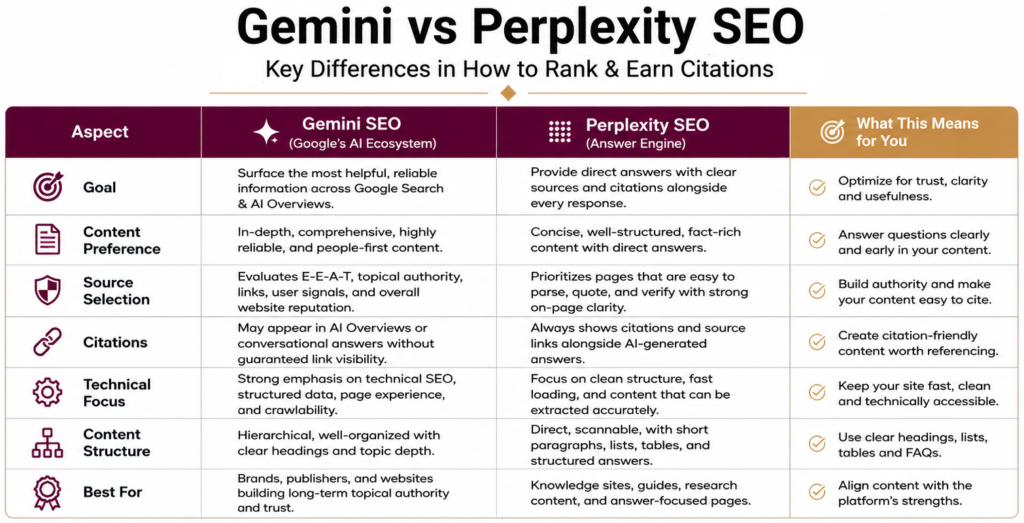
Gemini and Perplexity don’t randomly select websites. They prioritize sources that appear trustworthy, relevant, and capable of answering a user’s question accurately. While neither platform publishes its complete ranking formula, their documentation, product behavior, and Google’s guidance reveal several consistent patterns.
Understanding these patterns is essential if you want to optimize for Gemini or improve your Perplexity SEO strategy.
How does Gemini gather information?
Gemini powers several Google AI experiences, including AI Overviews. It relies heavily on Google’s existing search infrastructure to retrieve information before generating responses.
Google has explained that AI features build on Search’s long-standing quality systems rather than replacing them. That means many familiar SEO principles still apply. When evaluating content, Gemini is likely to favor pages that demonstrate:
- Strong relevance to the user’s query
- Original reporting or firsthand expertise
- Clear page structure
- Reliable factual information
- Consistent topical authority
- Positive trust signals across the web
- Easy crawlability and indexing
Google’s documentation also stresses that there is no special optimization for AI features beyond creating helpful, reliable, people-first content that search systems can understand. In other words, if your website already follows Google’s quality guidelines, you’re building the right foundation for Gemini SEO.
Example: Suppose someone asks:
“How does structured data help AI Search Optimization?”
Gemini may synthesize information from:
- Google Search Central documentation
- Schema.org documentation
- A technically detailed SEO guide
- A respected industry publication
Rather than copying one article, it combines information from several trusted sources and cites those references where appropriate.
How Perplexity Finds Sources
Perplexity works differently from traditional search engines because it is designed around answer generation from the beginning.
Instead of simply returning links, it retrieves information from multiple sources, summarizes them, and prominently displays citations alongside its answers. Perplexity tends to reward content that is:
- Comprehensive without being repetitive
- Well-structured
- Easy to quote
- Supported by evidence
- Published by authoritative sources
- Frequently referenced elsewhere
Unlike many traditional search experiences, Perplexity makes citations highly visible. Users can immediately inspect the webpages behind an answer, which increases the value of becoming a cited source.
This makes AI Citation Strategy especially important for websites seeking visibility through Perplexity.
Shared Signals Used by Both Systems
Although Gemini and Perplexity use different technologies, they often value similar quality indicators.
1. Relevance
The page should answer the user’s question directly. A page discussing “SEO trends” is less likely to be cited for a question about how to rank on Gemini than a page dedicated to Gemini optimization.
2. Authority
AI systems evaluate whether the source appears credible. Signals can include:
- Expert authorship
- High-quality references
- Strong reputation
- Consistent publishing history
- Recognition across the web
3. Original Information
Pages containing original research, firsthand experience, proprietary frameworks, or unique examples stand out. Content that simply repeats what’s already available has fewer reasons to be cited.
4. Structured Content
AI systems process information more efficiently when content follows a logical hierarchy. Helpful elements include:
- Clear H2s and H3s
- Short paragraphs
- Lists
- Comparison tables
- Direct definitions
- Step-by-step explanations
This is one reason Answer Engine Optimization overlaps closely with AI Search Optimization.
5. Entity Understanding
Modern AI systems understand concepts as connected entities rather than isolated keywords. Instead of focusing only on repeating phrases like Gemini SEO, they recognize relationships among concepts such as:
- Google Search
- AI Overviews
- Gemini
- Structured Data
- E-E-A-T
- Schema.org
- Search Quality
Building these contextual relationships strengthens Entity SEO and helps AI models understand the broader topic.
6. Freshness When Relevant
For topics involving technology, AI, product updates, or industry changes, newer information often receives preference. Updating important articles regularly signals that your information remains current.
Why Citations Matter More Than Rankings
In traditional SEO, success often meant earning Position #1. In AI search, success increasingly means becoming one of the sources referenced inside the generated answer. A citation offers benefits beyond visibility:
- Builds trust with readers
- Increases brand recognition
- Generates referral traffic
- Reinforces topical authority
- Improves long-term discoverability across AI-powered search
As AI-generated answers become more common, being cited can be just as valuable as holding a top organic ranking for many informational queries.
What Is an AI Citation Strategy?
An AI Citation Strategy is the process of increasing the likelihood that AI-powered search engines reference your content when generating answers. It focuses on earning trust rather than simply improving rankings.
Instead of asking, “How do I get more clicks?”, the better question becomes:
“Why would an AI system choose my content over hundreds of other pages covering the same topic?”
That shift changes how content should be planned, written, and maintained.
The Pillars of an Effective AI Citation Strategy
A strong AI Citation Strategy typically includes several interconnected elements:
Publish Original, Experience-Based Content
AI systems are more likely to cite content that adds something new. Examples include:
- Original research
- Case studies
- Proprietary frameworks
- Expert commentary
- Practical workflows
- Real-world testing
Pages that simply summarize existing information have fewer distinguishing signals.
Build Topical Authority
Publishing one article on AI search is rarely enough. Instead, create a connected knowledge hub covering related subjects, such as:
- AI Search Optimization
- AI Search Ranking
- Gemini SEO
- Perplexity SEO
- Structured Data
- Entity SEO
- Answer Engine Optimization
- Generative Engine Optimization
- Google AI Overviews
This interconnected structure helps search engines and AI systems understand that your website has depth on the subject, strengthening topical authority.
Make Content Easy to Quote
AI-generated answers often extract concise, self-contained explanations. Improve your chances of being cited by using:
- Direct definitions
- Answer-first paragraphs
- Bullet lists
- Comparison tables
- Numbered steps
- Clear examples
These formats are easier for both readers and AI systems to understand without losing context.
Support Claims With Trusted Sources
Reliable references strengthen trust. When discussing Google’s AI search guidance, for example, cite official Google documentation instead of relying solely on third-party interpretations.
Well-supported content aligns with E-E-A-T principles and reduces the risk of inaccuracies.
Maintain Accuracy Over Time
AI models increasingly value current information for rapidly evolving topics. Review important pages regularly to:
- Update screenshots
- Replace outdated recommendations
- Add new product changes
- Refresh statistics
- Expand sections where user intent has evolved
Consistently maintained content has a better chance of remaining relevant as AI search continues to evolve.
How RAG and Semantic Chunking Influence AI Citations
To master SEO for AI search, you must understand Retrieval-Augmented Generation (RAG). AI search tools do not read entire 2,000-word blog posts in real time. Instead, their scrapers slice content into 200 to 500-word semantic vectors (chunks).
If your page lacks modular structure, the LLM loses context when parsing your content.
Best Practices for Optimizing Content for Inclusion in AI Search Answers:
- The 50-Word Direct Answer Pattern: Start every H2 and H3 section with a concise, declarative 30–50 word summary before expanding into detail.
- Standalone Semantic Context: Avoid ambiguous pronouns (e.g., using “it”, “they”, or “this tool” at the start of paragraphs). Always state the full entity name (e.g., “Gemini AI Overviews parse HTML tables…”).
- Data-Dense Markdown Elements: LLMs extract structured tables, ordered numerical steps, and bold key-value pairs at a much higher rate than long wall-of-text paragraphs.
How to Optimize for Gemini
When optimizing your website for generative AI features on Google Search (such as AI Overviews), ensure your core answers appear in the first 50 words of each section.
To optimize for Gemini, focus on creating content that Google can easily crawl, understand, trust, and reuse in AI-powered search experiences. There is no separate “Gemini algorithm” to optimize for. Google’s official guidance states that the same practices that help your pages perform well in Search also support visibility in AI-powered experiences, including AI Overviews.
If your SEO strategy is built around keyword density or publishing large volumes of similar articles, it’s time to rethink that approach. Gemini rewards clarity, usefulness, and demonstrated expertise more than content written solely to rank.
1. Start With Search Intent, Not Keywords
Every page should answer one primary question thoroughly.
For example, if your topic is How to Rank on Gemini, don’t spend the first 500 words discussing the history of artificial intelligence. Readers—and AI systems—expect a direct answer immediately.
A strong page typically follows this pattern:
- Answer the question in the first paragraph.
- Explain why the answer is correct.
- Add examples, supporting evidence, and practical guidance.
- Address related follow-up questions naturally.
This answer-first structure aligns with both Answer Engine Optimization and AI Search Optimization (AI SEO) because it reduces the effort required to extract useful information.
2. Demonstrate Real Expertise
Gemini is designed to surface trustworthy information, especially for topics that influence business decisions, finances, health, or technology.
Ask yourself:
- Does this article include practical experience?
- Does it explain why, not just what?
- Does it reference reliable sources?
- Does it add something original?
For example, instead of writing:
“Structured data helps SEO.”
Explain how structured data improves machine understanding, which schema types are appropriate, and where it actually influences visibility. Specific, experience-based explanations are far more valuable than broad statements.
3. Build Strong Topic Clusters
One excellent article rarely creates authority on its own. Google has become better at understanding whether a website consistently covers a subject in depth. That’s where topical authority becomes important.
For a website focused on AI marketing, related content might include:
- AI Search Optimization
- AI Search Ranking
- Gemini SEO
- Perplexity SEO
- AI Citation Strategy
- Google AI Overviews
- Entity SEO
- Structured Data
- Answer Engine Optimization
- Generative Engine Optimization
These pages should link naturally to one another, helping both readers and search engines understand the broader subject.
4. Use Clear Heading Hierarchy
Gemini performs better when content has a logical structure. Instead of writing long blocks of text, organize information using descriptive headings. A clear hierarchy might look like this:
H2: How to Optimize for Gemini
H3: Focus on Search Intent
H3: Demonstrate Expertise
H3: Improve Technical Accessibility
Well-structured content is easier for readers to scan and easier for AI systems to interpret.
5. Make Your Content Easy to Understand
Google’s documentation repeatedly emphasizes creating content for people first. Simple writing doesn’t mean shallow writing. Instead:
- Define technical terms.
- Avoid unnecessary jargon.
- Keep paragraphs short.
- Explain concepts before expanding on them.
- Use examples where appropriate.
If someone new to AI search can understand your article, you’ve probably written it well.
6. Help Google Access Your Content
Even outstanding content can’t be cited if search systems struggle to crawl or process it. Review the basics:
- Fast loading pages
- Mobile-friendly design
- Crawlable HTML content
- Clean internal linking
- Descriptive page titles
- Logical URLs
- Appropriate structured data where relevant
Google specifically recommends ensuring that important content is accessible to its crawlers rather than hidden behind technical barriers.
7. Earn Brand Mentions Beyond Your Website
Gemini doesn’t evaluate pages in isolation. If respected publications, communities, industry experts, or academic sources mention your brand, those signals contribute to your broader online reputation.
This doesn’t mean chasing backlinks at any cost. Instead, focus on publishing content people naturally reference because it is genuinely useful.
How to Optimize for Perplexity
Perplexity SEO is less about ranking pages and more about becoming a reliable source worth citing. Because Perplexity prominently displays references alongside its answers, content that is easy to verify and quote has a clear advantage.
While traditional SEO remains important, Perplexity rewards pages that provide complete, evidence-based answers.
1. Write Citation-Friendly Content
Perplexity often extracts concise passages directly from high-quality pages. Help it do that by writing:
- Direct definitions
- Short explanatory paragraphs
- Lists
- Step-by-step processes
- Comparison tables
- Question-and-answer sections
Avoid burying key information inside lengthy introductions.
2. Support Every Important Claim
Evidence increases trust. For example:
Instead of saying,
“AI Search Optimization is replacing SEO.”
A better statement would be:
AI Search Optimization builds on traditional SEO by improving how AI-powered search systems retrieve, interpret, and cite content.
This distinction matches Google’s published guidance and avoids exaggeration.
3. Publish Original Examples
Perplexity frequently references pages that explain ideas clearly with practical examples. For instance, instead of defining entity SEO, show how Google connects entities like:
- Google Search
- Gemini
- Schema.org
- AI Overviews
- Knowledge Graph
Concrete examples improve understanding and make your content more useful.
4. Improve Readability
Long paragraphs reduce usability. A better structure includes:
- Two- or three-sentence paragraphs
- Bulleted summaries
- Tables where comparisons help
- Descriptive headings
Readable content benefits both human visitors and AI systems.
5. Refresh Important Pages
AI evolves rapidly. If your article still references outdated product names or obsolete features, it becomes less useful. Update important content regularly by:
- Revising screenshots
- Adding new documentation
- Expanding emerging topics
- Removing outdated recommendations
Freshness matters most when the topic changes quickly.
Off-Page AI Optimization: Building Citations Beyond Your Website
Optimizing your website on-page is only half the battle. Perplexity and Gemini constantly cross-reference web assertions against community discussions, news outlets, and third-party databases to confirm factual consensus.
- Knowledge Graph Consistency: Keep your corporate name, key leadership, service categories, and address identical across Wikipedia, Wikidata, Crunchbase, and official social channels.
- Community Citation Building (Reddit & Quora): Perplexity weights un-sponsored user discussions heavily. Active brand participation and organic mentions in industry subreddits directly feed the LLM’s citation layer.
- Digital PR and Co-Mentions: Earn mentions on high-authority industry publications alongside key category terms. When AI models see your brand entity repeatedly co-located with target concepts across independent sites, citation frequency increases.
The 10 Ranking Factors of AI Search Results
There isn’t a published checklist from Google or Perplexity that guarantees AI citations. However, based on Google’s documentation, search quality guidance, and how modern AI search systems behave, several signals consistently influence AI Search Ranking. These factors work together rather than independently.
| Ranking Factor | Why It Matters |
| 1. Helpful, Original Content | AI systems prefer information that provides genuine value instead of repeating existing articles. |
| 2. E-E-A-T Signals | Experience, expertise, authoritativeness, and trustworthiness help establish credibility, particularly for important topics. |
| 3. Search Intent Match | Pages that answer the user’s actual question are more likely to be retrieved and cited. |
| 4. AI Citation Strategy | Content with concise definitions, clear explanations, and supporting evidence is easier for AI systems to reference accurately. |
| 5. Topical Authority | A collection of related, interconnected articles demonstrates sustained expertise rather than isolated coverage. |
| 6. Entity SEO | Clearly defining people, organizations, products, and concepts helps AI models understand context and relationships. |
| 7. Structured Data | Schema markup helps search engines interpret page elements and can improve machine understanding, although it doesn’t directly guarantee rankings. |
| 8. Strong Internal Linking | Logical internal links help search engines discover related content and reinforce topical relationships across your site. |
| 9. Technical Accessibility | Fast, crawlable, mobile-friendly pages with clean HTML are easier for search systems to index and process. |
| 10. Brand Reputation and Mentions | Consistent references from trusted websites strengthen overall credibility and increase confidence in your content. |
Best Practices for AI Search Ranking
There isn’t a shortcut to consistent AI visibility. The websites that appear in Gemini, Perplexity, Google AI Overviews, and other AI-powered search experiences usually follow the same principle: they publish content that is genuinely useful, technically accessible, and trusted by both people and search systems.
Instead of chasing every new AI trend, focus on practices that are likely to remain valuable as search evolves.
1. Answer the Main Question Immediately
Readers and AI systems shouldn’t have to scroll through several paragraphs before finding the answer. A strong article typically follows this flow:
- Answer the question.
- Explain why the answer is correct.
- Add supporting details.
- Include examples, comparisons, or next steps.
This answer-first format improves readability while supporting answer engine optimization.
2. Write for One Topic Per Page
Trying to rank one page for unrelated topics often weakens its usefulness. For example:
Good Topic
- How to Rank on Gemini
Too Broad
- SEO Tips, AI Marketing, Social Media, Email Marketing, PPC, Branding, and Web Design
A focused page provides clearer context for both readers and AI systems.
3. Build Topic Clusters Instead of Isolated Articles
Publishing dozens of unrelated blog posts rarely establishes expertise. Instead, create connected content around one subject. For an AI Search Optimization hub, you might publish articles on:
- Gemini SEO
- Perplexity SEO
- Google AI Overviews
- AI Citation Strategy
- Entity SEO
- Structured Data
- Answer Engine Optimization
- Generative Engine Optimization
- Technical SEO for AI Search
- AI Search Ranking Factors
When these articles link naturally to one another, they reinforce topical authority and help search engines understand the depth of your expertise.
4. Support Important Claims With Reliable Sources
Trust matters more than ever. Whenever you reference product guidance, research, or technical recommendations, link to official documentation or well-established organizations.
Reliable references improve credibility for readers and align with Google’s E-E-A-T principles.
5. Use Structured Data Where Appropriate
Structured Data helps search engines understand the purpose of your content. Depending on the page, useful schema types may include:
- Article
- FAQPage (where supported and appropriate)
- Organization
- BreadcrumbList
- Person
- Product
Schema doesn’t guarantee AI citations, but it improves machine understanding and can contribute to richer search experiences.
6. Refresh Evergreen Content Regularly
Search changes continuously. An article published a year ago may still rank, but outdated examples or obsolete recommendations reduce its value. Review key content periodically to:
- Update screenshots
- Replace outdated terminology
- Add new Google guidance
- Expand emerging topics
- Remove information that no longer applies
Maintaining evergreen content is often more effective than constantly publishing new articles.
7. Build a Recognizable Brand
AI systems increasingly evaluate information beyond individual webpages. A trusted brand is more likely to be referenced across multiple search experiences. You can strengthen your brand by:
- Publishing consistently
- Demonstrating expertise
- Earning mentions from reputable websites
- Sharing original research
- Speaking at industry events
- Contributing expert commentary
Over time, these signals reinforce authority beyond traditional backlink metrics.
Top 6 Biggest AI Search Mistakes That Kill AI Visibility
Many websites don’t struggle because their content is bad. They struggle because it doesn’t provide enough reasons for AI systems to trust or reference it. Avoid these common AI search mistakes.
1. Publishing Rewritten Content
Articles that simply repeat information already available elsewhere rarely become preferred citation sources.
Ask yourself:
“What does this article contribute that readers can’t find elsewhere?”
If the answer is “not much,” revise before publishing.
2. Chasing Keywords Instead of Questions
Keyword optimization still matters. But AI search focuses much more on answering complete user questions. Rather than repeating AI search optimization dozens of times, explain:
- What it is
- Why it matters
- How it works
- When to use it
- Common misconceptions
Depth almost always beats repetition.
3. Ignoring E-E-A-T
Missing author information, unsupported claims, and vague advice reduce trust. Strengthen credibility by including:
- Expert authorship
- Reliable references
- Practical examples
- Firsthand insights where appropriate
Readers notice these signals and so do search systems.
4. Weak Content Structure
Dense paragraphs without headings are difficult to scan. Improve readability by using:
- Descriptive headings
- Short paragraphs
- Lists
- Tables
- Direct answers
Well-organized content benefits both users and AI retrieval systems.
5. Publishing Without Updating
AI evolves rapidly. Recommendations that were accurate a year ago may no longer reflect current search behavior. Schedule periodic reviews for your highest-value content.
6. Blocking Crawlers Accidentally
Technical issues can prevent excellent content from being discovered. Review:
- robots.txt
- Meta robots directives
- Canonical tags
- Crawl errors
- JavaScript rendering
- Page indexing
Visibility begins with accessibility.
7. Dedicated AI Search Optimization Tools
Following any AI optimization guide from Google requires tracking your brand’s share of AI voice. Useful tools include:
- Entity & Schema Auditing: Schema App, Inlinks, and Diffbot (for mapping knowledge graph connections).
- AI Visibility Tracking: Perplexity Pro API queries, ChatGPT brand monitoring pipelines, and specialized LLM tracking dashboards.
- Semantic Coverage Analysis: MarketMuse, Surfer SEO, and Clearscope (to ensure natural entity density).
Frequently Asked Questions About AI Search Optimization (AI SEO)
What is the difference between AI Search Optimization and Generative Engine Optimization (GEO)?
AI Search Optimization is a broad strategy that improves visibility across AI-powered search experiences such as Gemini, Perplexity, AI Overviews, and ChatGPT. Generative Engine Optimization (GEO) is a subset of that strategy focused specifically on increasing the chances that generative AI systems retrieve and cite your content in their responses.
Why are brand mentions and citations important for AI SEO?
Brand mentions from reputable websites reinforce your credibility and help establish authority around specific topics. AI systems evaluate more than individual pages. They also consider broader trust signals when deciding which sources to reference.
What technical elements are key to making content AI-ready?
Important technical foundations include crawlable HTML, logical site architecture, mobile-friendly design, fast-loading pages, descriptive headings, internal linking, and appropriate structured data. These elements help search engines access and understand your content efficiently.
How does E-E-A-T tie into AI SEO?
E-E-A-T—Experience, Expertise, Authoritativeness, and Trustworthiness—helps search systems evaluate content quality. Articles supported by expert knowledge, reliable references, firsthand experience, and accurate information are more likely to earn trust from both readers and AI-powered search systems.
Does structured data improve AI Search Ranking?
Structured data does not directly improve rankings or guarantee AI citations. However, it helps search engines interpret page content more accurately, making it easier to understand entities, page types, and relationships between information.
Can small websites rank in Gemini and Perplexity?
Yes. AI search systems regularly cite smaller websites when they provide original, well-structured, and trustworthy information. Strong topical expertise within a specific niche often matters more than overall domain size.
Is traditional SEO still important for AI search?
Absolutely. AI Search Optimization builds on traditional SEO rather than replacing it. Crawlability, technical SEO, quality content, internal linking, and user experience remain essential foundations for AI visibility.
Conclusion
AI search isn’t replacing traditional SEO. It’s expanding what success looks like. Instead of competing only for the top organic result, websites now have an opportunity to become trusted sources that power AI-generated answers across Gemini, Perplexity, Google AI Overviews, ChatGPT, and future search experiences.
The fundamentals haven’t changed as much as many headlines suggest. Helpful content, technical accessibility, clear site structure, trustworthy information, and demonstrated expertise continue to form the foundation of strong search performance.
If you consistently answer real questions better than competing pages, support your claims with reliable evidence, and build authority around your niche, you’ll be well-positioned for the next generation of search.
Looking to implement these strategies? Professional AI search optimization services help brands structure data, build entity authority, and secure reliable citations across LLM platforms.
Croccle helps brands stay discoverable in an AI-first search environment. We combine technical SEO, AI search optimization, structured content, entity-based SEO, schema implementation, and digital authority building to strengthen your visibility across ChatGPT, Gemini, Perplexity, Claude, and Google’s AI-powered search experiences. Our approach is designed to improve long-term brand recognition, trusted AI citations, and sustainable organic growth, not just rankings. Contact us now for digital marketing services in India.
About the Author
Dev Gupta (DG) is the Founder of Croccle, a digital growth consultancy helping businesses build a stronger online presence through SEO, AI search optimisation, content strategy, and performance marketing. With years of experience and a track record of working with 100+ brands across diverse industries, he shares practical insights to help businesses stay ahead in an evolving digital world.
Connect and follow him on LinkedIn